“It’ll be about five-ten minutes,” the hostess told me with sweet, Southern charm.
It was a Tuesday morning and I was looking for a quick breakfast before getting on with my day. The neighborhood southern-style restaurant, part of a chain, had a breakfast buffet that checked the “quick” box, but I hadn’t counted on hitting the morning rush.
“Wait,” I countered. “Don’t you have a back room?”
The hostess hesitated.
“Uh, yes,” she said tentatively. “You sure you want to sit there?”
“Sure,” I responded, looking at my watch. “Why not?”
In the back room, one family crowded around a single large table. Several other tables were unoccupied. I half-wondered why, but was still focused on how quickly I could get out of there. I was just grateful for the quick seat in a quieter spot to scan the morning paper as I ate.
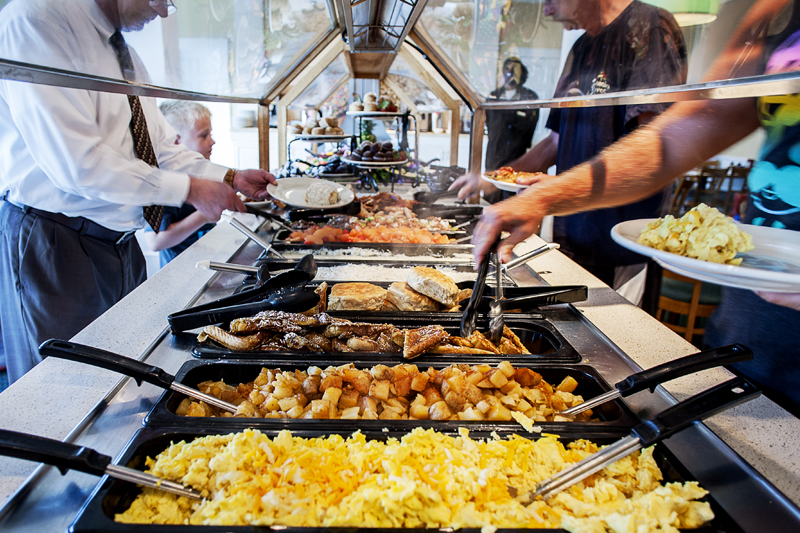
At the buffet, as I scooped a spoonful of eggs onto my plate, I surveyed the crowded dining room. I couldn’t quite cut through the morning fog of cognitive dissonance – one space full, another space near-empty. I stepped back into the back room with my breakfast plate, surveyed the big open space and thought, ‘I guess we’re the second-class citizens.’ That’s when the realization hit me full force.
We were the second-class citizens. All the patrons in the front dining room were white. I sat in the back with the only black people in the place.
It was yet another reminder that I was back in the Deep South. After growing up in the ethnic northeastern city of Syracuse, New York, I had taken a job as a TV reporter in the Mobile, Ala. – Pensacola, Fla. market. While I had immediately fallen in love with Florida, I felt out of place in such a “whitebread” culture. I remember jokingly asking my news director the location of the Italian section of Pensacola, so I could find a place to rent there. His teasing but accurate response was, “Wherever you live is the Italian section.”
After a year-and-a-half in the Florida Panhandle, I spent the next four years in the wonderfully multicultural city of Miami. I felt at home in the rich ethnic environment. Indeed, one friend noted my Italian features and Florida tan by saying, “This place is perfect for you; you can pass for anything – except Haitian!”
But it was now 1984. A career correction pushed me geographically north, up the Florida coast but, culturally, back to the South of the 1950s where too many people were still proudly fighting a war that ended more than 120 years earlier.

would never forget.
For me, that war and its racist attitudes were largely confined to their rightful place in the history books. I credit a five-word sentence from my father for that. One day, when I was about three or four years old, dad was toting me around a Shoppers Fair store. Looking around the aisles, I was conscious, for the very first time, that there were people whose skin was a whole lot darker than mine. I gripped my father tightly around the neck and told him I was scared. He chuckled and reassured me, saying, “People come in all colors!”
“Really?” I asked in wonder. “Red? Blue? Orange?”
“Yes,” he laughed, allaying my fears as I started looking all over for green and purple people.
After my experience at that restaurant, I wish I could say I did something effective, something that made a difference, other than answering “no” when the cashier asked if everything was alright. But being new to town, I was an outsider. Outsiders seldom have power – much like the hookers and lepers, the Samaritans and tax collectors of Jesus’ time. While it can be hard to be like Jesus, it’s easier to be more like my father, trying to neutralize our fear of “the other” by the way we live. Avoiding “polite” racism. And going to more places like the old Shoppers Fair that welcome people of all colors – even red, blue, and orange.
If you liked this story, I hope you will choose to subscribe. Just scroll down, enter your email address and click “Subscribe.” I try to upload a new entry every couple of weeks or so.
 Now What?