A common-sense look at the capriciousness of life in the post-fact 21st century from the perspective of a retired journalist and educator who is also a devout Catholic
Hmmm… wasn’t expecting to hear anything like that.
“Uh, actually, it’s tea. I’m drinking tea this morning.”
Makes a difference, I guess.
Helen and I were in the middle of our usual Sunday morning sprint, racing to get dressed and out of the house for early Mass. She was overloaded with teacup, clothes, shoes and who knows what else when the mishap hap’d. I was yielding the bathroom to her and was also overloaded – tea mug, phone, bottle of water, Bluetooth speaker, hair brush, beard brush, styling wax, towel and morning meds. Microcosms of two overloaded lives.
Something’s gotta give.
Like Dagwood and his sandwich-makings, most of us tend to overload ourselves – too much to carry, too much work, too many tasks.
Helen and I seemed to be living in a constant maze of tasks. Day-to-day work, family, and home responsibilities have snowballed. Much like most Americans; probably very much like you and your family. Even when our bodies force us to take a break, our minds are still dizzy with an increasing number of items on our to-do lists – at least some of which will never get to-done.
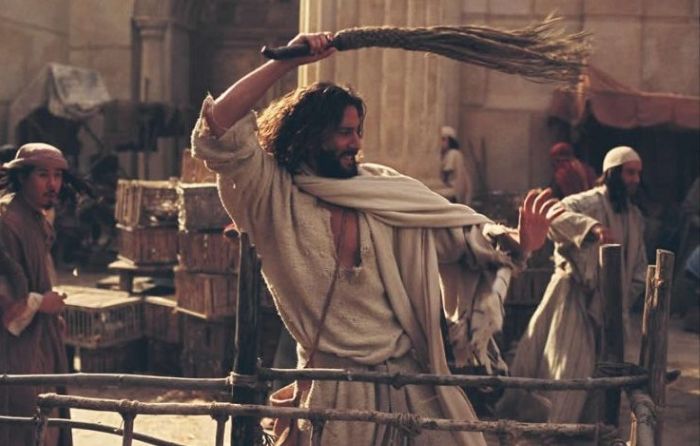
At Mass, just an hour later, that sense of overload was affirmed. The gospel reading was the story of Jesus cleansing the temple of the merchants and moneychangers. Solomon’s Temple was heart and soul of Jewish society, and it had become polluted by far too many extraneous elements that robbed it of its singular focus.
Fr. Jhon Guarnizo’s insightful homily hit a perfect bull’s eye, comparing the ancient Jerusalem temple as the dwelling place of Yahweh with our own hearts as home for the Holy Spirit. Just as Jesus drove out everything that did not belong inside the walls of that holy place, Fr. Jhon cited our need to dislodge “the rush of busy-ness, where we measure our days by productivity instead of prayer.”
Jesus cleansed the temple to put the focus back where it belonged. Today, it’s a metaphor for us to focus on the true substance of our lives.
No, we can’t ignore the laundry or the dishes. But maybe we can make a little time – ten minutes – for reading a daily devotional or Bible verse, and then offering a quick prayer for a loved one, either living or gone. Yes, we must still go to work, but maybe in the car we can stream “Let Me Be Frank” instead of “Howard 100.” And, overall, less doing and more reflecting. Something, anything, that reminds us we are human beings, not human doings.
Still, I don’t expect Helen and I will be changing our well-choreographed Sunday morning sprint. Just please don’t forward this post to her. The last thing she said before heading for the shower Sunday morning was, “And I don’t want to read about it in your blog!”
If you liked this post, I hope you will choose to subscribe. Just scroll down, enter your email address and click “Subscribe.” I try to upload a new entry every couple of weeks or so.
I was at the end of the bottled water aisle, stretching my 5’4” frame, trying to reach a gallon of distilled water on the top shelf. I looked down the aisle and wondered who the ma’am was, because I didn’t see anyone who needed help.
“I can get that for you, ma’am!”
I turned to see who in the world was seeing things. As soon as the stock boy saw the quizzical look on my bearded face, he was mortified.
“I’m sorry sir,” he babbled. “I’m really so sorry.”
I had no idea my hair had gotten this long over the many months I had kept my head away from styling scissors.
Hmmm… maybe I do need a haircut.
Time out for an explanation: I only cut my hair twice during the Covid year. After that, I let it go; I’m retired – and it’s only hair. And now, for the past couple of months, my stylist has been in and out of the hospital. But that’s not the point. Here’s the point – Things aren’t always as they seem. And sometimes misperceptions leave lasting impressions.
Youngsters are especially impressionable. I remember my first grade “church school” class – every Wednesday, the Catholic kids, almost all of us in our entire public school, would get out early and be bused to St. John the Baptist for our weekly religious instruction. The parish’s pastor also happened to be the auxiliary bishop,
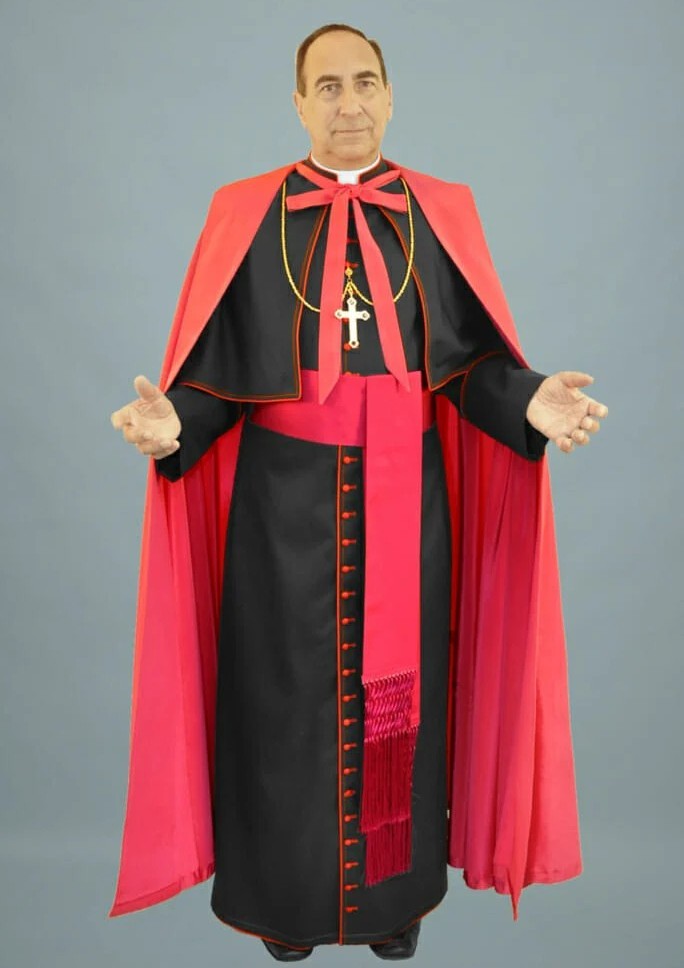
Any fully-robed bishop would have a tendency to intimidate a 7-year-old boy – and many people much older, too.
One Wednesday, the bishop – the Most Rev. David Cunningham – glided through the classroom door. He was stunningly resplendent in his red and black regalia, complete with skullcap (zucchetto) and flowing cape. As our teacher, a tiny young blonde woman, tentatively approached the bishop, he held out his hand, palm down. The woman dropped to her knees and kissed his ring.
For a seven-year-old Catholic boy, the message was loud and clear – priests, especially old, white-headed priests, were pretty much on the same level as God.
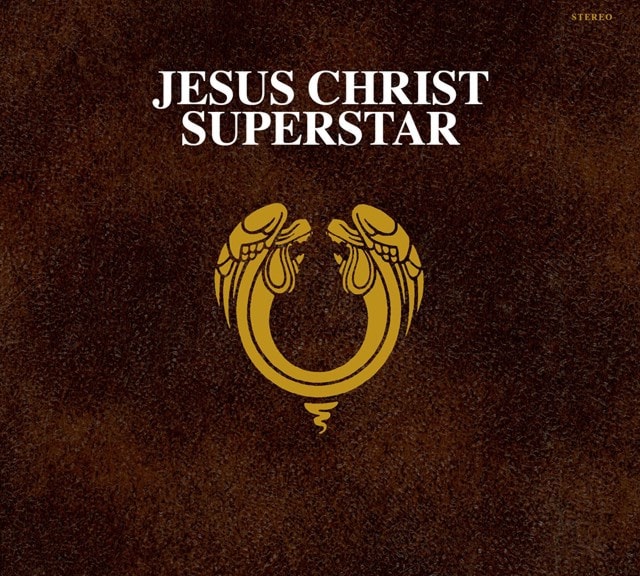
That impression lasted about seven years. But it was another old, white-headed priest who sowed the doubt. He was a visitor saying Sunday Mass in my boyhood church of St. Daniel in Syracuse. The rock opera Jesus Christ Superstar had been released a few weeks earlier. The priest spent a large part of his homily condemning the album, calling it heretical. So what do you think a 14-year-old boy steeped in popular music up to his ears is going to do? Yup, you guessed it.
Fifty-Six years after the rock opera’s release, Jesus Christ Superstar still provokes controversy among many Christians.
The experience was transformational. It wasn’t just the music, it was the message. Most impactful was The 39 Lashes. Each successive lash was increasingly intense, eventually causing me to flinch with each crack of the whip. The Passion was no longer a concept. The two-dimensional, black and white whipping jumped off the page of the gospel as the music exposed the profound reality of Jesus’ suffering.
Jesus Christ Superstar is not heretical – the Vatican endorsed it in 1999. Priests are not God. And I’m not a ma’am. But the stock boy reminded me the necessity for reassessing long-held beliefs, challenging tenets that may be the result of wrong impressions or misguided teachers. Maybe you’ll discover business as usual can become better, smarter and more rewarding business as usual – without having to endure any lashes.
If you liked this story, I hope you will choose to subscribe. Just scroll down, enter your email address and click “Subscribe.” I try to upload a new entry every couple of weeks or so.
People love a good story. We are storytellers at heart. We all experience the human adventure through stories.
Holy Week is one of those times in the Christian calendar that is rich with some of the greatest stories in human history – among them are the Last Supper, Judas’ betrayal and Peter’s denial, Jesus’ arrest, crucifixion and resurrection. These contain some of the greatest lessons in human understanding. The lights of these events shine so brightly, they tend to overshadow the stories within these stories.
Such is the case of Malchus.
Malchus was the slave of Caiphas, Israel’s high priest during that fateful Passover two centuries ago. Called a slave, Malchus was likely a ranking member of the high priest’s household. Think “executive secretary,” or “personal assistant.” As such, he most likely was well-schooled in Jewish law, scripture, and prophesy, and privy to all the high-level political plots.
In other words, Malchus was a smart guy and, as a fly on the wall, an ultimate insider. His story was notable enough to be mentioned the gospels, yet overshadowed by some of the most significant events of all time. Still, his story should register with all of us who ever contemplated the divine.
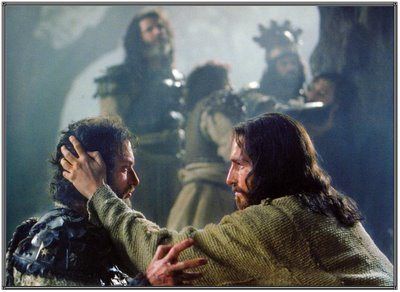
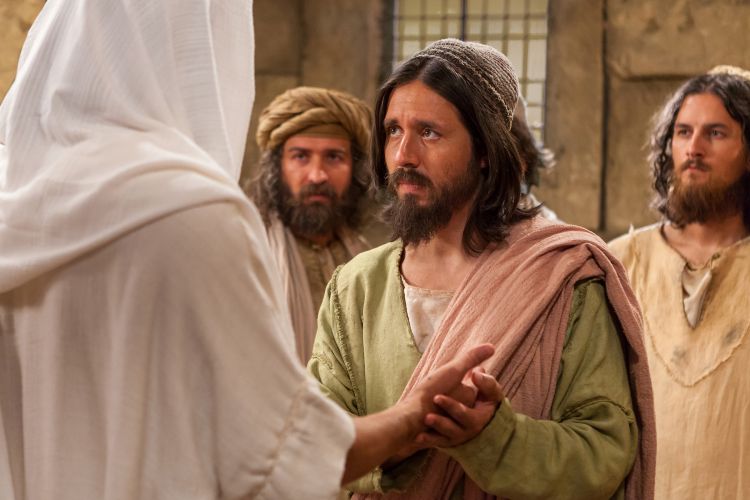
Jesus heals the wound of Malchus, the high priest’s slave, after one of the disciples cuts off his ear.
Malchus accompanied the temple cohort that arrested Jesus. According to all four gospels, one of the disciples – John 18:10 claims it was Peter – cut off Malchus’ ear.
This was NOT what Malchus signed up for.
Like most everyone else, Malchus was probably quite curious about this strange preacher. He’d heard all the stories about the signs and wonders. He couldn’t escape the shouts of “Hosannah to the Son of David!” that echoed through Jerusalem just five days earlier. And while Jesus caused a scandal routing the merchants and moneychangers from the Temple’s Court of the Gentiles, he had no reason to expect any significant resistance to the armed guards. Yet, here he was now, stunned and bleeding profusely from the gaping wound on the side of his head.
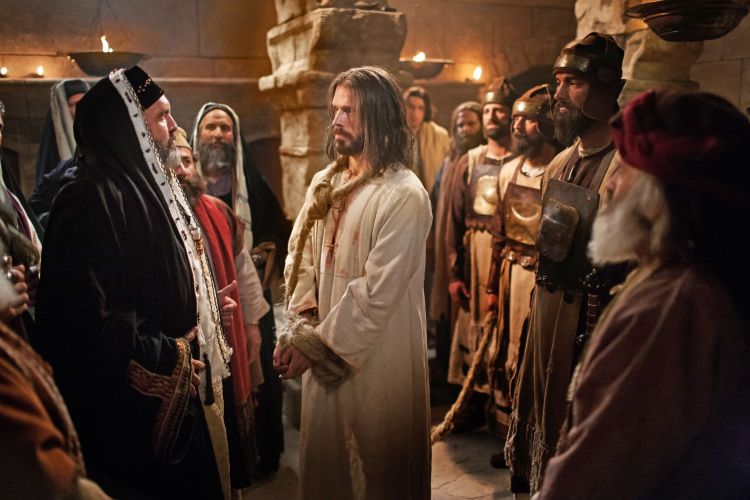
Following his arrest in the Garden of Gethsemane, Jesus is brought to the high priest Caiphas for trial by the Sanhedrin.
As he howled through the pain, Malchus must have thought Caiphas and the council were right – Jesus IS dangerous, a threat to Israel, to the Temple, to the nation, to their entire way of life. He’s a blasphemer, an affront to God, a destructive agent of evil. While grabbing at his wounded ear, his good ear picks up something about putting down a sword. He sees Jesus reaching for him out of the confusion, touching the throbbing side of his head and – WOW! Searing pain gone. Wound healed.
Who IS this Jesus guy?
The Risen Christ tells Thomas, “Blessed are those who have not seen and yet believe.”
Malchus – immersed in the law and traditions of Israel, inoculated against Jesus by the daily denunciations from Israel’s esteemed leaders – felt the ground shift beneath him. It was one thing to hear fantastic stories of all the supposed miracles this nomad preacher reportedly pulled off. But to be on the receiving end of an actual honest-to-goodness healing changed the entire landscape. This was cognitive dissonance in the extreme.
We don’t know if Malchus saw and believed. He is never again mentioned in any Bible text or historical document. Maybe he stuck with the religious establishment claiming Jesus’ resurrection was just another fraud. But just maybe Malchus became a believer. What we do know is that, ten days later, the risen Jesus told Thomas, “Blessed are those who have not seen and yet believe.” We don’t have to lose an ear to hear that message.
If you liked this story, I hope you will choose to subscribe. Just scroll down, enter your email address and click “Subscribe.” I try to upload a new entry every couple of weeks or so.
No, this headline is not a mistake, despite the title of my last post – Escaping the “No Place.” A dear, insightful, faithful soul, Jim Goodell, music director at Our Lady Star of the Sea Catholic Church in Ponte Vedra Beach, made a keen observation. He noted that sometimes it’s necessary to say “no” in order to say “yes.”
Here’s one example that may sound familiar: If I had said “no” to those couple of late-morning chocolate chip cookies I just scarfed down, it would help to eventually say “yes” to the jeans hidden in the back of the closet for the past several months.
In addition to his duties at Our Lady Star of the Sea, Jim Goodell (left) is also founder, producer and singer for the Bella Voce Cabaret.
Yeah, that’s a pretty trivial example. But it clearly illustrates how getting rid of one roadblock can make possible something even better. Saying “no” can be a critical part of our everyday lives in ways that enrich us and those we love.
Maybe this one time, guys, it would be prudent to say “no” to watching the game at a sports bar with your buds so you can say “yes” to a relaxing day trip to reconnect with your wife. And ladies, can you say “no” to that grocery run? If so, you can say “yes” to a glass of wine and some “remember when” time with your husband.
Sometimes spending time with family or a spouse is worth watching a game at a sports bar with friends.
Yes, I know – gender stereotypes. But easily understood stereotypes make points quickly, and gender roles isn’t the main topic, so maybe you can cut me a little slack? Hey, it’s not like I don’t cook and clean too. Right Helen? (Uh… Helen??)
So Jim is right – saying “no” can lead to many more rewarding yeses. And he notes these things aren’t limited to our daily routines. Saying “no” can also apply to more significant aspects of our lives.
No one likes being the “odd man out,” the one nonconformist who becomes the center of attention by being different. The one holdout on an 11-1 jury vote. A lone Dallas Cowboys fan at a Philadelphia Eagles’ home game. Wearing a tux to a toga party. Our tendency as humans is to blend in, not be “that guy” or “that lady.” But that’s exactly what Jesus commissioned us – through the Apostles – to do: “Go into all the world and proclaim the good news to the whole creation” (Mk 16:15).
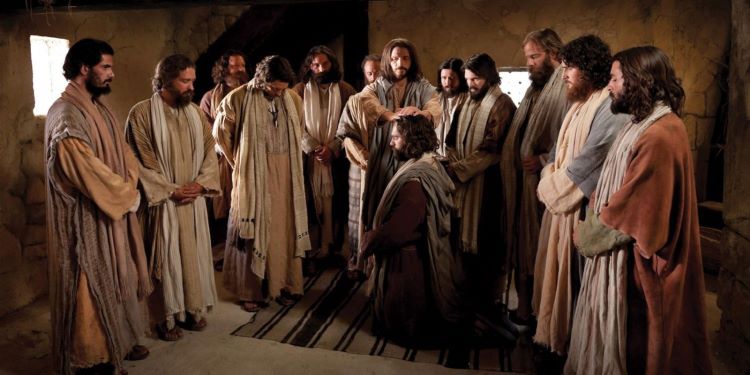
Jesus commissioned all his followers, through these 12 apostles, to spread the Good News of salvation throughout the world.
Engaging the Holy Spirit, the Apostles and their successors were so successful, Christianity became the societal norm through much of world over the past 2,000 years. As such, it wasn’t so tough to talk about God, Jesus, and religion. Today, the popular American “normal” is shifting to “no God.” Even a former president’s son is widely promoting the Freedom from Religion Foundation, saying he’s “not afraid to burn in hell.” So when you have to fight against the tide of society, it’s easy to say “no.”
This is the “no” we have to overcome to say “yes” to Jesus’ commission. That “yes” may bring ridicule and embarrassment. You may even alienate a few friends and family members. That’s a big risk. Then again, countless spiritual predecessors risked – and lost – their lives for saying “yes” to Jesus. In that context, risking embarrassment and ridicule isn’t so bad. It’s good timing, too. With Lent fast approaching, sacrificing our pride may be easier than giving up cookies – even chocolate chips!
If you liked this story, I hope you will choose to subscribe. Just scroll down, enter your email address and click “Subscribe.” I try to upload a new entry every couple of weeks or so.
When I began this “Now What” series, I made a deliberate decision to move away from exclusively religious/Christian/Catholic topics. Each installment, however, usually contained a connection or an analogy to a Biblical principal – the purpose being to illustrate that God isn’t “out there,” but right here among all of us. This piece, however, will be different. This time, I’m jumping into the fire.
During his trip to Asia a few weeks ago, Pope Francis, speaking to an interreligious group of young people in Singapore, made the following statement:
Every religion is a way to arrive at God. There are different languages to arrive at God but God is God for all. But my God is more important than your god, is that true? There is only one God and each of has a language to arrive at God. Sikh, Muslim, Hindu, Christian, they are different paths.
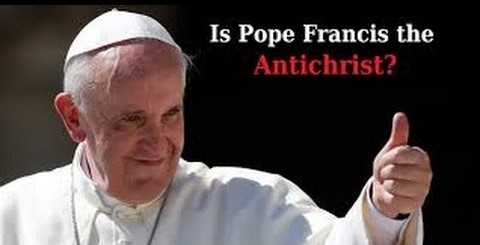
Pope Francis’ message to young people in Singapore – that all religions are different languages to arrive at God – generated a firestorm among conservative Catholics and Christians, clerics and laity alike.
His remarks were widely interpreted – misinterpreted, actually – to claim that every religion is equally true. The backlash was immediate, vitriolic, and often hateful. The extreme reactions wounded my heart deeply, not simply because it deluged Francis with venom. Not only because of the judgmental absolutism. Not just because of the limits it put on God. But because it completely wrote off billions of people as unworthy of God’s love.
Every human being ever born was created in the image of God and wrapped in His infinite and unconditional love. Original sin, however, has separated us from God; only perfection can exist in God’s presence. It is Jesus’ redemptive death that purifies us, as reflected in Scripture: “Jesus said to (Thomas), ‘I am the way and the truth and the life. No one comes to the Father except through me.’” (Jn 14:6) That is an unequivocal statement from Jesus. A universal truth.
Yet…
At this moment in time, there are about 8.2 billion people living on earth. About 2.4 billion are Christian. Assume, for argument’s sake, half of the 5.8 billion non-Christians have at least heard of Jesus, what’s to be said of the nearly three billion people who, through no fault of their own, are ignorant of the savior? Would the God of unimaginably perfect love create even one person who, by circumstances of birth and culture, has no possible pathway to salvation?
Islam, with 1.91 billion followers – the second largest religion to Christianity – considers Mecca, the birthplace of Muhammed, its holiest site.
If reactions to Pope Francis’ statements are any indication, the answer is unreservedly “yes.” Blowback from Catholic clergy and publications – mostly conservative and historically critical of the pontiff – was delivered with an iron fist in a velvet glove. Texas bishop Joseph Strickland, already removed from his position for challenging the pope on social issues, asked the faithful to pray for Francis. The pope should “clearly state that Jesus Christ is the only Way,” Strickland wrote. “To deny this is to deny Him. If we deny Christ, He will deny us, He cannot deny Himself.” Catholic priest and broadcaster Fr. Calvin Robinson was more direct, writing, “The Scriptures teach us the opposite. The gate to heaven is narrow.” And a Christian publication concluded, “The false doctrine which Francis proclaimed has been around for centuries … Pray for Pope Francis to repent of his false teaching and come to know the true Gospel.”
Many faithful, Catholic and Protestant alike, were not nearly as measured on social media.
“As a Catholic I openly say this is a heretic Pope we have, no two ways about it. He has denied Jesus and his teachings.”
“The Roman Catholic Church is an abomination invented by an emperor. A complete bastardization.”
“The pope needs to read the Bible. All of his heresies are debunked in the Holy Word of God.”
“I’ve always known this pope to be corrupt.”
“The default condition of mankind is condemnation. There is no need for us to add to it.”
“The Pope is misleading too many. Jesus will hold him accountable.”
Online social media contain numerous articles and images vilifying Christianity, especially Pope Francis and the Catholic Church.
Many of these accusations prompt me to recall the many New Testament stories of the Pharisees adhering to the strict letter of the Law. The Gospels, however, are rich with stories of Jesus infusing God’s infinite love and mercy into the Law. Examples include the woman caught in the act of adultery, the apostles “harvesting” grain to eat on the sabbath, and the many instances of healing. In each of these examples, Jesus violated Jewish law. But He used these examples to show that man does not exist to benefit the law, but the law exists for the benefit of man.
Still, I am not so arrogant to believe I know and understand the mind of God. When I face an especially difficult issue, I usually defer to my favorite parable – the Parable of the Workers in the Vineyard (Mt 20:1-16). In it, the landowner pays the same wage to those who worked just one hour as those who worked 12 hours.
The most common interpretation of this parable is that a deathbed conversion by a person with a lifetime of sins will spend eternity in heaven with Jesus – the same reward awaiting a person who’s been faithful for an entire lifetime. The key is accepting Jesus. I believe this with my entire being.
Yet…
Those who know me are not surprised I see an additional interpretation here.
Just like the workers who showed up at dawn, Jesus gave me my requirements for my eternal reward – believe in Him, and work for Him. The deal he makes with others – their requirements for eternal life with him in heaven – is simply not my concern. “Take what is yours and go,” says landowner/Jesus. “What if I wish to give this last one the same as you? Am I not free to do as I wish with my own money?”
The Catechism of the Catholic Church states emphatically and unequivocally that Jesus Christ is the mediator of the world, the only way of salvation (846). Yet, it recognizes its most important dogma can not and should not be used to limit the power and the reach of Almighty God.
This affirmation is not aimed at those who, through no fault of their own, do not know Christ and his Church: Those who, through no fault of their own, do not know the Gospel of Christ or his Church, but who nevertheless seek God with a sincere heart, and, moved by grace, try in their actions to do his will as they know it through the dictates of their conscience – those too may achieve eternal salvation (847).
None of us has any idea how and when Jesus will enter into this equation. That’s not for us to know. It is not for us to put limits on God’s grace by refusing to recognize He can reach these people in His own way and in His own time. He will bestow His grace to anyone He wishes. That’s all I need to know. That, and to be thankful for blessing me with His grace during my own time on earth.
If you liked this installment, or if you were challenged by it, I hope you will choose to subscribe. Just scroll down, enter your email address and click “Subscribe.” I try to upload a new entry every couple of weeks or so.
Our eyes were locked; his arms up with palms out. As John lowered his arms, I trusted him enough to follow, dropping my body in perfect synch with his motion. It was almost as though John, the third base coach, was controlling me with a video game joy stick. Just as John dropped his arms straight down, my foot hit the bag, sliding in to beat the tag from the third baseman. My focus on the coach was the reason I was safe, successfully taking the extra base from first to third on a single to center field.
In one of his Syracuse Senior Cyclones softball games, Dad wasn’t able to tag the runner out at third in part because of the help of the third base coach.
It was a softball game in the Media League – a league composed of employees of several media outlets. It was your typical beer league. I opted for coffee in my to-go cup, though, as just the thought of chugging PBRs at 8:30 on a Saturday morning made my stomach churn.
The type of focus John and I had between us at that moment doesn’t happen very often. Still, most of us have experienced it, some more than others, me more than most. You see, I was named Peter, after the apostle, because my mother intuitively recognized I’d be an impetuous hardhead, just like Jesus’ No. 1 guy.
Yes – Here comes the analogy.
I recently had the occasion to stumble upon the story of Jesus walking on water (Mt 14:22-33). I like to think Peter was able to get out of the boat and walk toward Jesus on the stormy Sea of Galilee only because of his trust, and an extreme laser-like focus on Jesus. Being a mere mortal, though, at some point Peter had to look around and think ‘This is crazy! What am I doing?’
It’s hard to imagine what was going through Peter’s mind when he jumped out of the boat and started walking toward Jesus. It’s easier to understand his fear after he did.
That was the moment Peter sank into the angry sea, only to cry out, ‘Lord, save me!’
Peter was a human no different from you and me. How many times have I lost focus on Jesus and started to drown? A lot. Way too often.
I know you’ve been there, too. That’s just how life is. So, if and when you start sinking when trying to walk on your own raging waters, there’s a rescuer you can trust. A coach to get you home safe. A lifeguard. A savior. Once you slide across the plate, or are you’re back on dry land, go ahead and crack open a cold one to celebrate – even if you don’t play softball.
If you liked this story, I hope you will choose to subscribe. Just scroll down, enter your email address and click “Subscribe.” I try to upload a new entry every couple of weeks or so.
Many years ago, in a land far, far away, there were two friends. They worked at the same job with a handful of other friends. They bought into the mission statement and approached their job with a single focus. Because the work was so intense, they became very close – brothers in spirit.
At a critical point, both of them made two of the worst choices since the beginning of time. That’s when their paths diverged. One became the founder of the Church and now identifies those who get to spend eternity in the rapturous light of heaven. The other became known as the most evil, despicable traitor in the history of man.
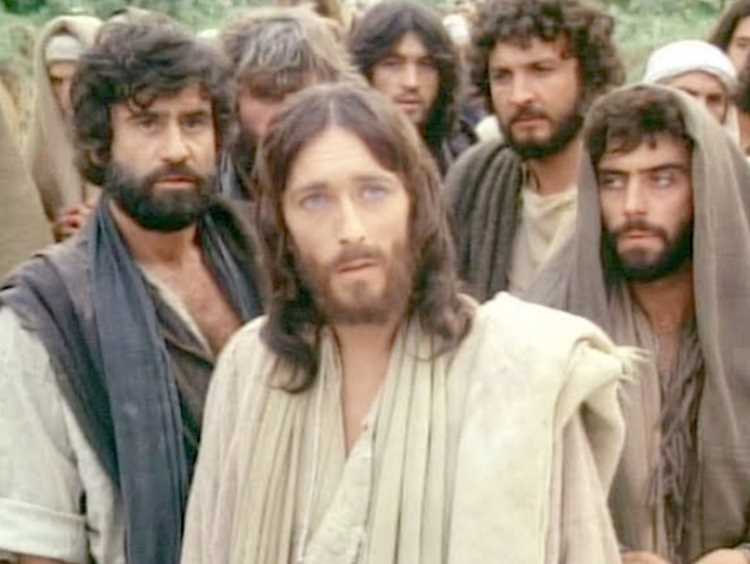
Peter (left) and Judas (right) lived and worked together for three years as they accompanied Jesus on his ministry – as illustrated in the miniseries Jesus of Nazareth.
Yes, Peter and Judas. Two comrades who, within a few hours of each other, turned their backs on Jesus. Their subsequent actions resulted in the greatest divergence of destinies since God said, “Let there be light.” One was broken by his betrayal. The other destroyed. Their two very different fates is a great irony of human history.
Jesus knew both of his friends would fail him. He said as much during the Last Supper. But even though Judas had thought out his betrayal, none of the Bible accounts focus on his motivation – citing only financial motives and that “Satan entered into him.” In the absence of certainty, possibilities arise. Maybe Judas hoped the Jewish leaders would be more accommodating after His trial. It’s possible he disagreed with the direction the ministry had turned. Judas may have feared their success could spark a Jewish revolt that would lead to a bloody Roman repression.
Peter’s regret over denying Jesus was crushing; asking Jesus for forgiveness restored him.
Peter is much easier to understand. His impulsiveness is well documented throughout Scripture – jumping out of boats, telling Jesus to avoid Jerusalem, cutting off a slave’s ear – so denying Jesus in a knee-jerk reaction of self-preservation was not out of character for him.
Both men traveled with Jesus for three years, worked with Him, lived with Him, and listened to Him preach and teach. They experienced His unconditional love. They saw acceptance and understanding. They witnessed Jesus reveal the value and the dignity of every human being no matter how dirty and diseased in body and spirit they were.
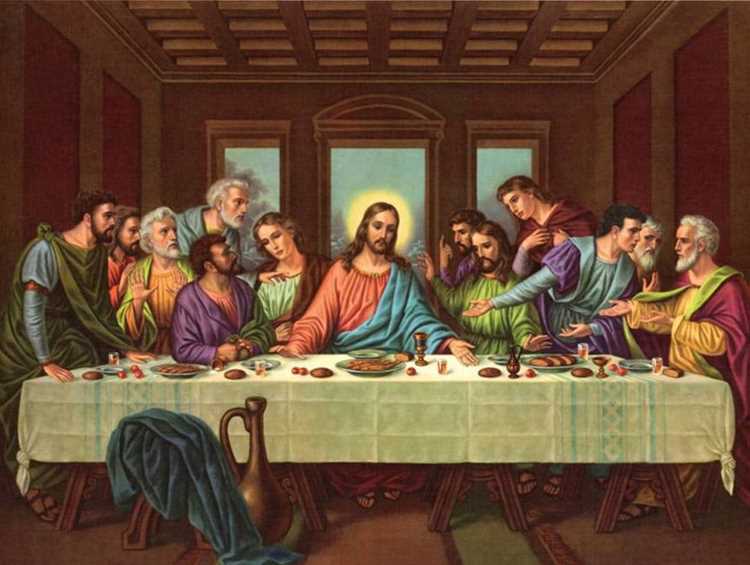
Jesus knew at the Last Supper that both Peter and Judas would, in their own ways, betray Him.
As the magnitude of their denials sunk in, both became despondent and wracked with guilt. But Peter understood the significance of Jesus’ ministry. Judas missed it. Thus, the two brother-apostles took opposite paths to remedy their betrayals.
Whether pride, arrogance, shame, guilt, or some other reason, Judas turned his back on Jesus and his brother apostles. All he had to do was say “I’m sorry” and ask for forgiveness. Instead, he became the definitive example of deceit, treachery and betrayal. Peter’s path of repentance, by contrast, led him to become the ultimate example of Jesus’ unconditional love and infinite forgiveness – a fate that could have belonged to Judas.
Two brothers in Jesus. Near identical transgressions. Separated for eternity by the words, “I’m sorry.” Granted, they are words that can be excruciatingly hard to say. But words with life and death consequences. Words worth contemplating during our Lenten journey.
If you liked this story, I hope you will choose to subscribe. Just scroll down, enter your email address and click “Subscribe.” I try to upload a new entry every couple of weeks or so.
“I would never kill myself; but I just wish I was dead.”
The words popped into my head without prompting. It was a dark, chilly, rainy late afternoon in October 2004. I was approaching my bus stop after a damp, sloppy three-block walk from my office in the communication school at the University of North Carolina. I was a 48-year-old graduate student, older than many of my professors, just a couple of months into a three-year fellowship, all alone in a new city when my life crashed around me. I was barely functional, numb from the medication that was necessary to survive each day. My only desire was darkness – permanent darkness.
The instant after those horrible words shot through my consciousness, my phone rang.
“Hey man, I was thinking of you, wondering how you’re doing!”
The bright voice on the other end of the phone was John Thomas, my dear friend from the St. Joseph’s Church choir back home in Jacksonville. Understanding there are no coincidences, I immediately recognized the call was a lifeline from God, the first of many during this dark period.
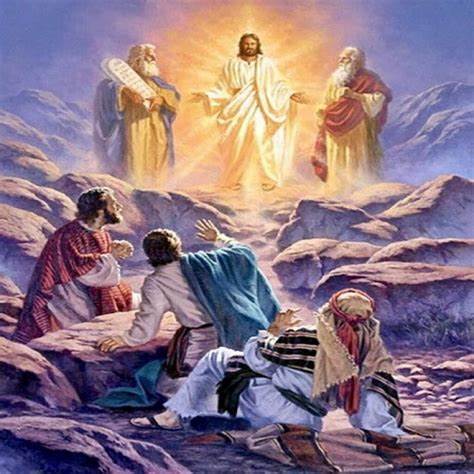
Moses and Elijah visited Jesus in the Transfiguration possibly to lift His spirits and remind Him of the glory of a successful earthly mission.
John became, in a sense, my Moses and Elijah. God sent John to me in much the same way, I believe, that he sent Moses and Elijah to Jesus during the Transfiguration. Matthew, Mark and Luke give an excellent account of what happened during that supernatural encounter. But only Luke hints at why they appeared or what they said. Luke writes they “spoke of his exodus that he was going to accomplish in Jerusalem.”
What??
Would God, the Loving Father, really send these two pillars of heaven to remind his Son – as if Jesus really needed reminding – that he would be betrayed, tortured and crucified in a matter of months? Sorry, I’m not buying it. Maybe a look at the timeline of Jesus’ earthly ministry may give us a different look.
After a couple of years of preaching and teaching, healing and exorcisms, it’s well within reason to believe Jesus was feeling the pressure of failure. He knew time was running out. His true message just wasn’t getting through. He amassed thousands of followers who wouldn’t leave Him alone, not because they understood His message about the Kingdom of God but because they wanted more loaves and fishes, and hoped for liberation from Rome. He was even vexed by His own apostles, asking them in frustration, “Do you still not understand?”
Jesus’ ministry threatened the prevailing power structure of Israel – both Rome and the Jewish religious hierarchy, especially the ruling Sanhedrin.
Not only that, the religious and political establishments were coalescing in deadly opposition. To them, He had grown from a minor irritant to a legitimate threat to the political, social, and economic structure they ruled. It was only a matter of time before they put an end to it – and Him. Jesus knew that even before they did. He had known it most of His life. But having to endure it was just so difficult!
At this point in his ministry, how could Jesus’ human nature not be disheartened and dispirited. It’s not ridiculous to think that, in this most critical endeavor in the history of the cosmic universe, Jesus, the human being, felt He was failing.
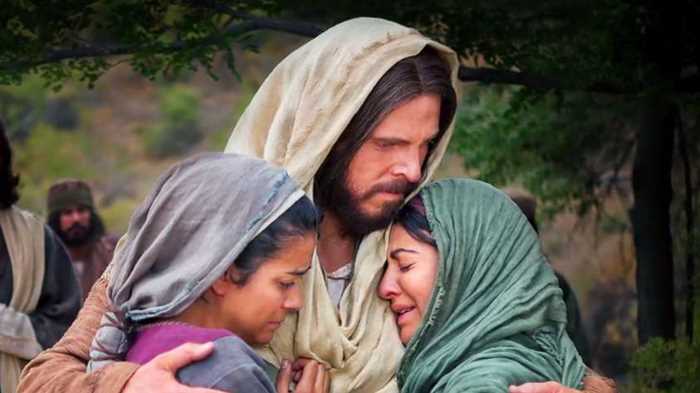
We are never beyond God’s healing touch, sometimes directly through our hearts and sometimes through family and friends who love us.
God, the Loving Father, knew that Jesus, the human Son, needed a heavenly boost. Moses and Elijah likely reminded Jesus that He could – would – persevere, accomplish His mission and reconcile all humanity to the Father. That the entire realm of heaven would explode in glory when He finally defeated death. That His death and resurrection would secure the Kingdom of God for all eternity. Just hold on a little longer.
God even added a cherry on top for Jesus, audibly saying, “This is my beloved Son. Listen to him.”
A Loving Father comforts His suffering children. All of his children. Yes, including us. Sometimes He whispers to our hearts. Sometimes he sends surrogates. Like Moses. Or Elijah. Or a John Thomas. But He sends comfort. Just ask.
Because nothing is ever too difficult.
If you liked this story, I hope you will choose to subscribe. Just scroll down, enter your email address and click “Subscribe.” I try to upload a new entry every couple of weeks or so.










 Now What?