A common-sense look at the capriciousness of life in the post-fact 21st century from the perspective of a retired journalist and educator who is also a devout Catholic
Author: Dr Peter Casella
Peter Casella is a veteran journalist and educator. He retired in 2021 but continues to work part-time as a substitute high school teacher, and does electronic graphics for the minor league Jacksonville Jumbo Shrimp baseball team. Originally from Syracuse, NY, he is a lifelong Catholic. He is a member of St. Joseph’s Church in Jacksonville, Fla., serving in the music ministry since 1986. Dr. Casella received his PhD in Mass Communication-Journalism from UNC-Chapel Hill in 2004.
I have been a Jacksonville Jaguars season ticket holder for each year of the team’s existence – spending tens of thousands of dollars on the franchise over the past 30 years. This year is likely my last.
The Jacksonville Jaguars began playing in the NFL in 1995.
I have retained my seats every year because I’m a crazy, lifelong fan of NFL football. From the Giants as a grade-schooler, to the Dolphins after they drafted Larry Csonka in 1966, to the Jags in 1995. I love NFL football; the Jags were exciting and the team was dedicated to winning.
Less than 24 hours after one of the Jaguars’ worst performances in its history, a 12-7 loss to the Minnesota Vikings, I heard a radio commercial for the next home game, December 1 against the Houston Texans. Houston is a division rival, is atop the division standings, and has some fantastic playmakers like WR Nico Collins, RB Joe Mixon, and QB CJ Stroud. So how are the Jags marketing the game?
“Come see the Jaguars in their new custom designer cleats!”
Cleats?? Really??
The Jags “fan experience” includes watching games from swimming pools.
If I want to go to a fashion show, I’ll go… well, I’ll go to a psychiatrist. I guess if I want to see football I need to go elsewhere. Because this franchise sure isn’t selling, or playing, NFL football. The commercial tells me loudly and clearly that the people who run this franchise are not serious about building a long-term or even short-term winner.
The team started marketing the “fan experience” several years ago. (See “Swimming pools”) To be fair, the actual football product just wasn’t marketable. It stunk. I stopped feeling valued as a season ticket holder but stayed anyway – simply out of my love for the game. Now, after hearing the “cleats commercial,” I feel used, mocked, and even pimped.
Enough is enough.
Everbank Field will be replaced in two years by a new $1.4 billion stadium, with 55% of the cost coming from public tax dollars.
Two years from now, the Jaguars will be playing in a brand new, state-of-the-art, $1.4 billion stadium – $775 million will be financed by public tax dollars. I suspect ticket prices will take a big jump, too.
I can’t do anything about the public funding, but I can do something about my own discretionary budget. The NFL RedZone is a heck of a lot cheaper, and I get to see all NFL games from my couch. The beers won’t cost $18 each. And the “men’s room” is just steps away – with no line.
And then, for all I care, the Jags can wear pink ballet slippers.
If you liked this story, I hope you will choose to subscribe. Just scroll down, enter your email address and click “Subscribe.” I try to upload a new entry every couple of weeks or so.
When I began this “Now What” series, I made a deliberate decision to move away from exclusively religious/Christian/Catholic topics. Each installment, however, usually contained a connection or an analogy to a Biblical principal – the purpose being to illustrate that God isn’t “out there,” but right here among all of us. This piece, however, will be different. This time, I’m jumping into the fire.
During his trip to Asia a few weeks ago, Pope Francis, speaking to an interreligious group of young people in Singapore, made the following statement:
Every religion is a way to arrive at God. There are different languages to arrive at God but God is God for all. But my God is more important than your god, is that true? There is only one God and each of has a language to arrive at God. Sikh, Muslim, Hindu, Christian, they are different paths.
Pope Francis’ message to young people in Singapore – that all religions are different languages to arrive at God – generated a firestorm among conservative Catholics and Christians, clerics and laity alike.
His remarks were widely interpreted – misinterpreted, actually – to claim that every religion is equally true. The backlash was immediate, vitriolic, and often hateful. The extreme reactions wounded my heart deeply, not simply because it deluged Francis with venom. Not only because of the judgmental absolutism. Not just because of the limits it put on God. But because it completely wrote off billions of people as unworthy of God’s love.
Every human being ever born was created in the image of God and wrapped in His infinite and unconditional love. Original sin, however, has separated us from God; only perfection can exist in God’s presence. It is Jesus’ redemptive death that purifies us, as reflected in Scripture: “Jesus said to (Thomas), ‘I am the way and the truth and the life. No one comes to the Father except through me.’” (Jn 14:6) That is an unequivocal statement from Jesus. A universal truth.
Yet…
At this moment in time, there are about 8.2 billion people living on earth. About 2.4 billion are Christian. Assume, for argument’s sake, half of the 5.8 billion non-Christians have at least heard of Jesus, what’s to be said of the nearly three billion people who, through no fault of their own, are ignorant of the savior? Would the God of unimaginably perfect love create even one person who, by circumstances of birth and culture, has no possible pathway to salvation?
Islam, with 1.91 billion followers – the second largest religion to Christianity – considers Mecca, the birthplace of Muhammed, its holiest site.
If reactions to Pope Francis’ statements are any indication, the answer is unreservedly “yes.” Blowback from Catholic clergy and publications – mostly conservative and historically critical of the pontiff – was delivered with an iron fist in a velvet glove. Texas bishop Joseph Strickland, already removed from his position for challenging the pope on social issues, asked the faithful to pray for Francis. The pope should “clearly state that Jesus Christ is the only Way,” Strickland wrote. “To deny this is to deny Him. If we deny Christ, He will deny us, He cannot deny Himself.” Catholic priest and broadcaster Fr. Calvin Robinson was more direct, writing, “The Scriptures teach us the opposite. The gate to heaven is narrow.” And a Christian publication concluded, “The false doctrine which Francis proclaimed has been around for centuries … Pray for Pope Francis to repent of his false teaching and come to know the true Gospel.”
Many faithful, Catholic and Protestant alike, were not nearly as measured on social media.
“As a Catholic I openly say this is a heretic Pope we have, no two ways about it. He has denied Jesus and his teachings.”
“The Roman Catholic Church is an abomination invented by an emperor. A complete bastardization.”
“The pope needs to read the Bible. All of his heresies are debunked in the Holy Word of God.”
“I’ve always known this pope to be corrupt.”
“The default condition of mankind is condemnation. There is no need for us to add to it.”
“The Pope is misleading too many. Jesus will hold him accountable.”
Online social media contain numerous articles and images vilifying Christianity, especially Pope Francis and the Catholic Church.
Many of these accusations prompt me to recall the many New Testament stories of the Pharisees adhering to the strict letter of the Law. The Gospels, however, are rich with stories of Jesus infusing God’s infinite love and mercy into the Law. Examples include the woman caught in the act of adultery, the apostles “harvesting” grain to eat on the sabbath, and the many instances of healing. In each of these examples, Jesus violated Jewish law. But He used these examples to show that man does not exist to benefit the law, but the law exists for the benefit of man.
Still, I am not so arrogant to believe I know and understand the mind of God. When I face an especially difficult issue, I usually defer to my favorite parable – the Parable of the Workers in the Vineyard (Mt 20:1-16). In it, the landowner pays the same wage to those who worked just one hour as those who worked 12 hours.
The most common interpretation of this parable is that a deathbed conversion by a person with a lifetime of sins will spend eternity in heaven with Jesus – the same reward awaiting a person who’s been faithful for an entire lifetime. The key is accepting Jesus. I believe this with my entire being.
Yet…
Those who know me are not surprised I see an additional interpretation here.
Just like the workers who showed up at dawn, Jesus gave me my requirements for my eternal reward – believe in Him, and work for Him. The deal he makes with others – their requirements for eternal life with him in heaven – is simply not my concern. “Take what is yours and go,” says landowner/Jesus. “What if I wish to give this last one the same as you? Am I not free to do as I wish with my own money?”
The Catechism of the Catholic Church states emphatically and unequivocally that Jesus Christ is the mediator of the world, the only way of salvation (846). Yet, it recognizes its most important dogma can not and should not be used to limit the power and the reach of Almighty God.
This affirmation is not aimed at those who, through no fault of their own, do not know Christ and his Church: Those who, through no fault of their own, do not know the Gospel of Christ or his Church, but who nevertheless seek God with a sincere heart, and, moved by grace, try in their actions to do his will as they know it through the dictates of their conscience – those too may achieve eternal salvation (847).
None of us has any idea how and when Jesus will enter into this equation. That’s not for us to know. It is not for us to put limits on God’s grace by refusing to recognize He can reach these people in His own way and in His own time. He will bestow His grace to anyone He wishes. That’s all I need to know. That, and to be thankful for blessing me with His grace during my own time on earth.
If you liked this installment, or if you were challenged by it, I hope you will choose to subscribe. Just scroll down, enter your email address and click “Subscribe.” I try to upload a new entry every couple of weeks or so.
Our eyes were locked; his arms up with palms out. As John lowered his arms, I trusted him enough to follow, dropping my body in perfect synch with his motion. It was almost as though John, the third base coach, was controlling me with a video game joy stick. Just as John dropped his arms straight down, my foot hit the bag, sliding in to beat the tag from the third baseman. My focus on the coach was the reason I was safe, successfully taking the extra base from first to third on a single to center field.
In one of his Syracuse Senior Cyclones softball games, Dad wasn’t able to tag the runner out at third in part because of the help of the third base coach.
It was a softball game in the Media League – a league composed of employees of several media outlets. It was your typical beer league. I opted for coffee in my to-go cup, though, as just the thought of chugging PBRs at 8:30 on a Saturday morning made my stomach churn.
The type of focus John and I had between us at that moment doesn’t happen very often. Still, most of us have experienced it, some more than others, me more than most. You see, I was named Peter, after the apostle, because my mother intuitively recognized I’d be an impetuous hardhead, just like Jesus’ No. 1 guy.
Yes – Here comes the analogy.
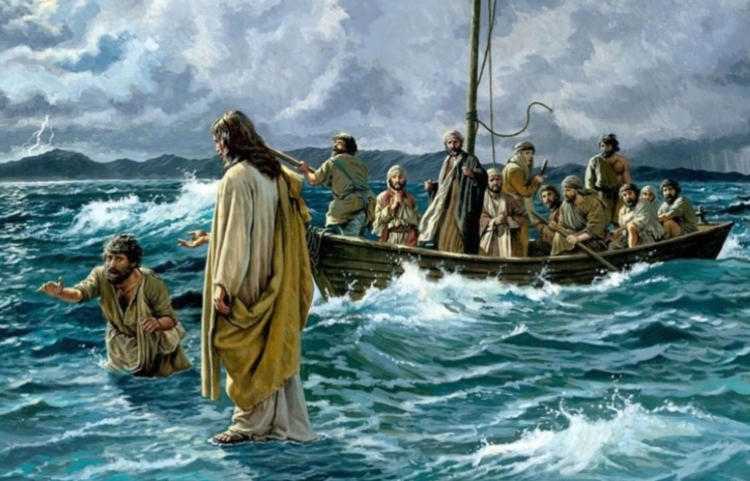
I recently had the occasion to stumble upon the story of Jesus walking on water (Mt 14:22-33). I like to think Peter was able to get out of the boat and walk toward Jesus on the stormy Sea of Galilee only because of his trust, and an extreme laser-like focus on Jesus. Being a mere mortal, though, at some point Peter had to look around and think ‘This is crazy! What am I doing?’
It’s hard to imagine what was going through Peter’s mind when he jumped out of the boat and started walking toward Jesus. It’s easier to understand his fear after he did.
That was the moment Peter sank into the angry sea, only to cry out, ‘Lord, save me!’
Peter was a human no different from you and me. How many times have I lost focus on Jesus and started to drown? A lot. Way too often.
I know you’ve been there, too. That’s just how life is. So, if and when you start sinking when trying to walk on your own raging waters, there’s a rescuer you can trust. A coach to get you home safe. A lifeguard. A savior. Once you slide across the plate, or are you’re back on dry land, go ahead and crack open a cold one to celebrate – even if you don’t play softball.
If you liked this story, I hope you will choose to subscribe. Just scroll down, enter your email address and click “Subscribe.” I try to upload a new entry every couple of weeks or so.
I learned several years ago why the bathroom scale always spewed out numbers that were much higher than I anticipated – I have a much heavier-than-normal right foot. It’s no big deal. The only time it’s an issue is when I weigh myself. Oh yeah, and sometimes when I drive.
I don’t really drive fast. I just drive at my own pace. Which is usually faster than many other drivers. Actually, I dispute the belief that a fellow retiree and Jacksonville Jumbo Shrimp fan calls me Speedy because of the times I’ve passed him on I-95 heading to the ballpark. I’m sure he’s really calling me Speidi – after the grilled chicken marinade made famous near my hometown of Syracuse.
There are two driving speeds in Florida – very fast, which is usually okay, and really slow, which is really dangerous.
But my speed, no matter how fast I’m going, is always “reasonable.” If not, I’d have a couple more speeding tickets than I do – just three in more than 50 years of driving. That in itself qualifies me to declare any driver who passes me a “jerk” – or any other four, six, or eight-letter epithet that might cross my mind.
One reason for my perceived road immunity is that I’m in Florida, where the official vehicle of interstate driving is the 1998 McLaren F1. Posted speed limits are actually treated as minimum speeds. Driving below the speed limit poses a real danger for being run off the road. I-4, the interstate that runs from Daytona Beach to Tampa, is the unofficial Autobahn of Florida. Anyone driving the stretch of I-75 between Ocala and Tampa had best be in the state of grace.
Recently, while driving north on I-95 in Jacksonville, I heard what I assumed was a Saturn V rocket misdirected from down the road at the Kennedy Space Center. Before I could engage my lightning-fast driving reflexes, a silver sports car flew by me so fast I couldn’t tell the make or the model. I immediately began a rapid-fire Act of Contrition but not even halfway through, I heard a second roar, followed by the flash of a white Chevy Camaro – not mine – trying to catch the first speeder.
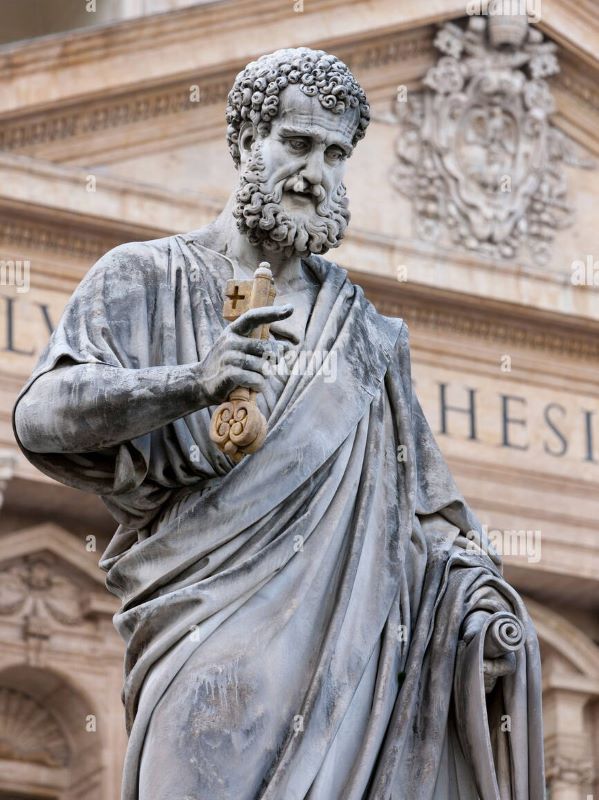
We may hold the keys to the car, but St. Peter holds they keys to the Kingdom.
Why is there never a cop car around to catch idiots like that, I asked myself. Those drivers deserved to be punished, I thought, as I cruised past all the other northbound cars on I-95. That’s when I once again realized my definition of a dangerous driver was any driver who passes me.
Please tell me I’m not the only one who thinks that way. I mean, people who do things worse than us deserve to be punished. You and I don’t. For me, I always have very good reasons for my transgressions. A) I’ve always done it this way. B) I’ve never gotten in trouble for it before. C) I’m really a good person!
Somehow, when I envision making those arguments to St. Peter at the gates of Heaven, he’s always shaking his head ‘no.’ And I’m not talking about my driving habits.
Luckily, Jesus doesn’t wear a state trooper’s uniform. Unlike a cop, though, He does see everything. Still, unlike the officer with a radar gun, Jesus is much more likely to let us off with a warning – penance after Reconciliation. And, unlike a judge, Jesus doesn’t suspend our sentence; instead, He expunges our record. All we have to do is ask.
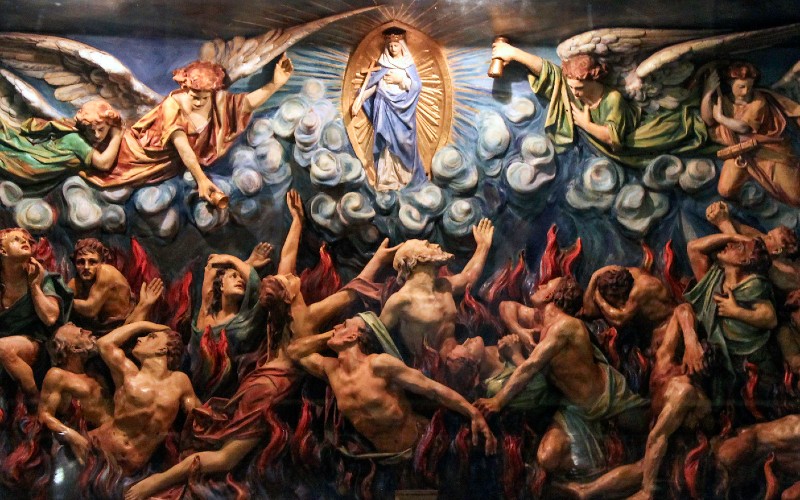
Purgatory is a stop on the way to Heaven that we’d all like to bypass.
Just because Jesus has given us the opportunity to secure a free Get-Out-of-Hell card (Thanks, Fr. Ruchinsky!) that doesn’t mean we should abuse His graces. Just like a speeding ticket can cost us a fine and higher insurance rates, our earthly transgressions could mean a detour to Purgatory, delaying our ETA in Heaven – the one destination we want to get to as soon as spiritually possible.
If you liked this story, I hope you will choose to subscribe. Just scroll down, enter your email address and click “Subscribe.” I try to upload a new entry every couple of weeks or so.
Now that I’m getting used to a couple of new pieces of metal in my knee, my fingers are finally getting reacquainted with my keyboard. Coincidentally, a trip I took just before this summer’s knee replacement caused me to recollect getting another piece of metal in the mail more than 50 years ago.
I had been awaiting the package eagerly. When it finally arrived, I couldn’t wait to tear open the box and inspect my new prized possession. One glance, though, and I was shocked, mortified and embarrassed all at once. My brand-spanking new, bright, shiny, 10-karat gold high school class ring had a punctuation error.
I was shocked, mortified and embarrassed by the rogue apostrophe in the school’s name on our class ring.
And I was responsible.
The next day back at school, I made a beeline to the office, where the principal informed me no, it would not be possible to recall and recast every ring for the Class of 1974. In other words, the mistake would be memorialized for all time.
I assigned myself responsibility for the mistake for one simple reason – as junior class president, one of my responsibilities was the design of the class ring. To be h0nest, my input was limited. It involved one meeting with the company rep to review and ratify the placement of dates and icons from previous designs. I never saw a mock-up of the final design. In other words, there was no opportunity to spot the rogue apostrophe that somehow wormed its way into my high school’s name. Still, the buck stopped with me.
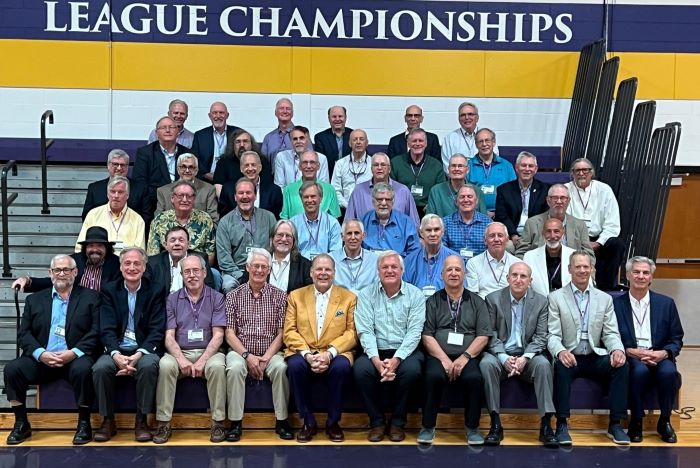
Even those of us who had no contact with classmates for 50 years were able to resume relationships where we left them back in 1974.
The error, I believed, was especially egregious because the school, Christian Brothers Academy, is perennially the highest-ranked college preparatory school in upstate New York. A foolish mistake like that could tarnish a reputation. So when I saw the eight-letter word incorrectly spelled “Brother’s” instead of “Brothers,” I spontaneously unleashed a string of shorter, four-letter words.
I can’t remember if the screw-up ever came up with any of my classmates back then. Yet, more than 50 years later, I’m still reminded of it when I slip my ring on each morning – including the weekend of our 50th anniversary reunion.
It’s safe to assume I was the only person who thought about class rings at all that weekend. Once the preliminaries were out of the way – the handshakes and the stares at name tags of guys who looked 50 years older than they did 50 years ago – most of us found the same comfort zones we occupied in our prior lives. But with a new appreciation of what we had shared in those four important formative years.
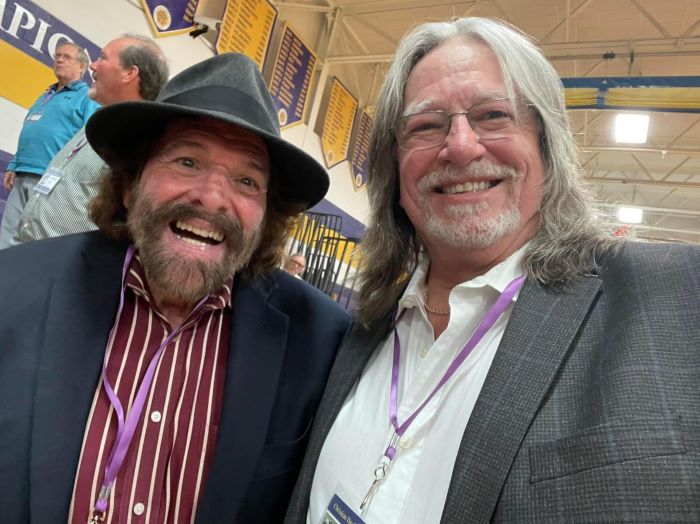
As members of CBA’s Class of 1974, Peter Wynyard and I had more in common than our names and our affinity for hair.
In many ways, the culture of our high school was a cross between The Paper Chase and Animal House. As a Catholic college preparatory school, expectations were exceptionally high. So high that most of us found our freshman year in college – Ivy League and otherwise – to be a cakewalk. At the same time, CBA was a single-gender school back then. All boys. Between the ages of 14 and 18. ’Nuf said. The bonds forged in that hyper-pressurized social and academic atmosphere were built to last a lifetime – even among those of us who had little or no engagement with our classmates. The reunion only strengthened those indelible bonds. Even stronger than a misplaced apostrophe cast in gold.
The ring error did not cause CBA to suffer a fatal blow to its reputation. The embarrassment did not affect enrollment. Future generations of Brothers – male and female – established an even greater academic standing over the decades. After 50 years, the only thing that had changed was my perspective – a change my Brothers classmates significantly reinforced that reunion weekend.
If you liked this story, I hope you will choose to subscribe. Just scroll down, enter your email address and click “Subscribe.” Under usual circumstances, I try to upload a new entry every couple of weeks or so.
Several years ago, after our church choir sang at a funeral Mass for a fellow parishioner and good friend, I told our music director, Frank DeProspo, that I wanted him to play the instrumental “piano exit” to the original Layla at my funeral. With a twinkle in his eye, Frank responded, “You know that’s not liturgically correct,” to which I answered, “This, coming from a guy who played Margaritaville at Tom Williamson’s funeral!”
Derek and the Dominos – really Eric Clapton and friends – released Layla and Other Assorted Love Songs in 1970. It was the band’s only album.
Another fellow choir member overheard us and asked me, “Why Layla?” I gave her a flippant, off-the-cuff answer. That answer felt disrespectful, and I’ve regretted ever since. But honestly, I had no idea how to answer truthfully. To me, music is a language, the language of my soul. Unfortunately, there’s no “Music to English” dictionary that can find the right words to express the meanings and emotions of a composition. It took a high school choir class to find those words for me.
One of my retirement jobs is working as a substitute teacher. Subbing keeps me in the classroom while allowing me to set my own schedule. The exception is when I get a request from Madeline Poe, the choral director at Beachside High School in St. Johns, Florida. When she texts, I’m there. She’s a phenomenal teacher, a better person, and her students are always wonderful. I sometimes even think of the kids as my own, even though they’re not. Recently, these students helped me find an accurate “music vocabulary,” and a whole lot more.
Madeline Poe’s chorus students – all three classes of them – at Beachside High School in St. John’s, Florida.
On this particular day, the students took the initiative to rehearse the showcase piece of their upcoming spring concert, a medley from Phantom of the Opera. But it was far from a traditional practice session. All discipline went out the window. Oh, the student singers hit every note dead on and in perfect balance – but all while mugging to the music! They jumped and twirled and danced and bounced and whirled each other around with not one iota of self-consciousness. Their faces glowed as they surrendered to the joy of the moment. It seemed as though they had shattered their human shells to reveal their true nature – the real nature God created within us all.
Too often, I “define” people by their appearance or their roles in relation to my life. A check-out clerk. A corporate executive. A bike-rider. I think other people – maybe even you – do the same thing. Unfortunately, when we do that, we don’t see the humanity behind the function. And when that happens, we can’t overcome the superficial, man-made differences that prevent us from seeing the dignity of each and every person we encounter.
Beachside High School choral students rehearsing Masquerade – a much more sedate and controlled session!
That realization is the gift Madeline’s kids gave me. After more than half a century, it helped me understand why Layla’s instrumental coda captivates my soul. It expresses joy. It reflects finality, timelessness, and eternity all at the same time. It exposes our humanity. It’s a reminder that we’re all made in God’s image and should always – always – treat each other that way. And that’s one heck of a lesson from a bunch of undisciplined high school kids.
If you liked this story, I hope you will choose to subscribe. Just scroll down, enter your email address and click “Subscribe.” I try to upload a new entry every couple of weeks or so.
I’m assuming there’s a good chance, after reading the title, that you’re ready to put up your dukes. That’s okay; I get it. But before this gets personal, let me re-establish my bona fides: I am a devout and lifelong Catholic who went to public school K-8 before moving to a private, Catholic high school where we prayed at the beginning of every school day and before each and every class. We even had special Masses. Things you would expect in a Catholic school.
And, really, that’s my point. We all shared a common religion – except for my friend Howie Rothstein, but he chose to be there so he was cool with it. Students who go to public schools, however, have no choice. There’s no common religion. So why do school prayer advocates want to require prayer in public schools?
Advocates say school prayer reminds students of a higher power and can help remedy societal ills such as bullying, violence, teenage pregnancy and more.
Other advocates say school prayer can address maladies such as bullying, increased violence, mass shootings, teenage pregnancy, illegal drug use and more.
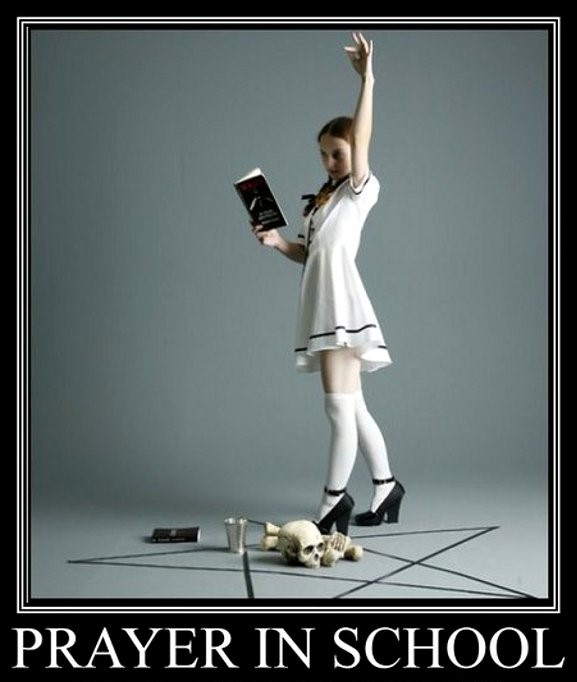
Okay. So which religion has such blanket transformative power? Remember, in public schools, all religions by law would enjoy equal favor. Most religious people in the U.S. belong to one of the many various branches of Christianity, so obviously Christian prayer would be included. What about a Jewish prayer? That should be okay – our Christian heritage is rooted in Judaism. Would parents welcome Islamic prayer in this political climate? Moreover, required school prayer would also legitimize atheism, Wiccan, and even Satanism, giving them a seat at the school-prayer altar. Do we really want our kids to pray “Dear God” on Monday and “Dear Satan” by Friday?
It’s doubtful this is what school prayer advocates have in mind, yet this is what is possible if prayer is ever required in public schools
If our Christian majority claims requiring prayer in public schools is necessary to remedy the ills of society, then we must not be fulfilling our responsibilities outside the classroom. Does that sound harsh? Well, it is harsh. But it’s also harsh to hear a 14-year-old boy defy me in the classroom by saying, “I’m not going to let some minimum-wage substitute nobody tell me what to do.” It’s even harsher when a police officer has to ask my wife, a full-time school teacher who’s been physically pushed around in class, “Do you want to press charges, Mrs. Casella?” Is school prayer the best way to address these bad behaviors?
It’s not the 1950s any more. Requiring prayer in public schools will not bring Wally and the Beaver back to the classroom. Heck, even Beavis and Butthead are long gone.
It’s ironic that a people blessed with free will by our Creator wants to force its will on other people to whom God has also granted free will. Forced prayer is the equivalent of beating someone until morale improves. It’s not just counter-productive; it’s contrary to God’s plan for us. So where does that leave us?
This truism probably dates back to the first schoolhouse exam. We are blessed to be in a nation in which no one can prevent us from praying,
When parents send their kids to school, teachers act in loco parentis; in the absence of parents, teachers must act in the best interests of the kids. But parents still need to act like parents when they are there. And we all need to act as Christians all the time.
Jesus, commenting on the Pharisees, told his followers to “do what they say, not what they do.” As adults, we can distinguish that difference. Our kids can’t. Children do what we do; what we say matters less. And, because the largest single religious group in America is “None,” too many kids are not being exposed to the most important influence in our lives – actually, in the universe. That makes our example so much more important than ever. We must spread God’s love, peace and joy through our actions – not by force – to everyone we encounter, especially our children.
We want people to think “I want what they have.” That’s meaningful evangelization. That’s our commission straight from Jesus.
And that will have a far greater affect than any required school prayer ever could.
Feel strongly about the subject? Please leave a comment. Either way, I hope you will choose to subscribe. Just scroll down, enter your email address and click “Subscribe.” I try to upload a new entry every couple of weeks or so.
Many years ago, in a land far, far away, there were two friends. They worked at the same job with a handful of other friends. They bought into the mission statement and approached their job with a single focus. Because the work was so intense, they became very close – brothers in spirit.
At a critical point, both of them made two of the worst choices since the beginning of time. That’s when their paths diverged. One became the founder of the Church and now identifies those who get to spend eternity in the rapturous light of heaven. The other became known as the most evil, despicable traitor in the history of man.
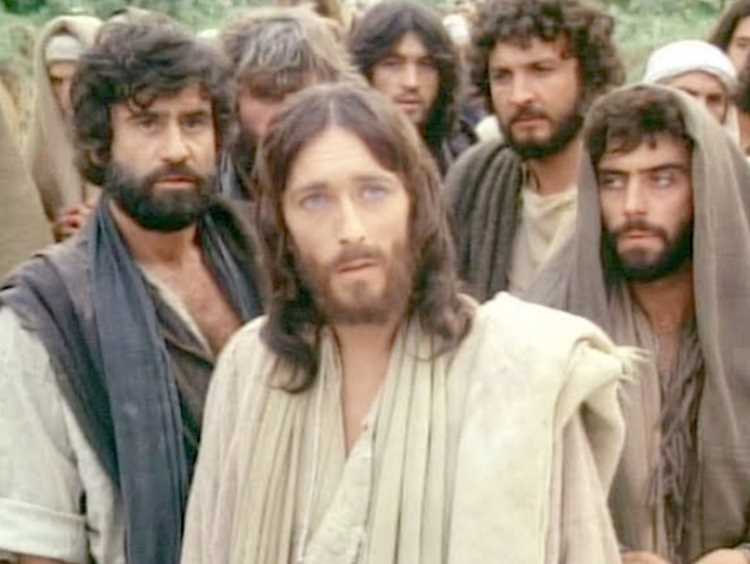
Peter (left) and Judas (right) lived and worked together for three years as they accompanied Jesus on his ministry – as illustrated in the miniseries Jesus of Nazareth.
Yes, Peter and Judas. Two comrades who, within a few hours of each other, turned their backs on Jesus. Their subsequent actions resulted in the greatest divergence of destinies since God said, “Let there be light.” One was broken by his betrayal. The other destroyed. Their two very different fates is a great irony of human history.
Jesus knew both of his friends would fail him. He said as much during the Last Supper. But even though Judas had thought out his betrayal, none of the Bible accounts focus on his motivation – citing only financial motives and that “Satan entered into him.” In the absence of certainty, possibilities arise. Maybe Judas hoped the Jewish leaders would be more accommodating after His trial. It’s possible he disagreed with the direction the ministry had turned. Judas may have feared their success could spark a Jewish revolt that would lead to a bloody Roman repression.
Peter’s regret over denying Jesus was crushing; asking Jesus for forgiveness restored him.
Peter is much easier to understand. His impulsiveness is well documented throughout Scripture – jumping out of boats, telling Jesus to avoid Jerusalem, cutting off a slave’s ear – so denying Jesus in a knee-jerk reaction of self-preservation was not out of character for him.
Both men traveled with Jesus for three years, worked with Him, lived with Him, and listened to Him preach and teach. They experienced His unconditional love. They saw acceptance and understanding. They witnessed Jesus reveal the value and the dignity of every human being no matter how dirty and diseased in body and spirit they were.
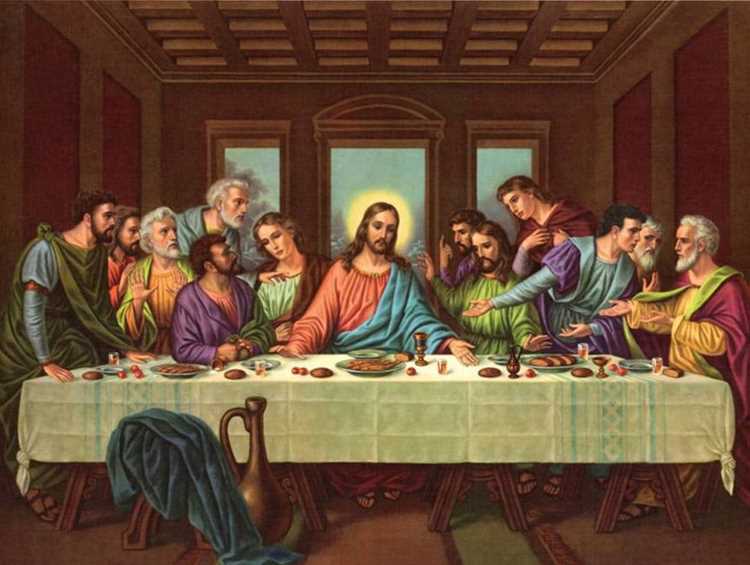
Jesus knew at the Last Supper that both Peter and Judas would, in their own ways, betray Him.
As the magnitude of their denials sunk in, both became despondent and wracked with guilt. But Peter understood the significance of Jesus’ ministry. Judas missed it. Thus, the two brother-apostles took opposite paths to remedy their betrayals.
Whether pride, arrogance, shame, guilt, or some other reason, Judas turned his back on Jesus and his brother apostles. All he had to do was say “I’m sorry” and ask for forgiveness. Instead, he became the definitive example of deceit, treachery and betrayal. Peter’s path of repentance, by contrast, led him to become the ultimate example of Jesus’ unconditional love and infinite forgiveness – a fate that could have belonged to Judas.
Two brothers in Jesus. Near identical transgressions. Separated for eternity by the words, “I’m sorry.” Granted, they are words that can be excruciatingly hard to say. But words with life and death consequences. Words worth contemplating during our Lenten journey.
If you liked this story, I hope you will choose to subscribe. Just scroll down, enter your email address and click “Subscribe.” I try to upload a new entry every couple of weeks or so.
“I would never kill myself; but I just wish I was dead.”
The words popped into my head without prompting. It was a dark, chilly, rainy late afternoon in October 2004. I was approaching my bus stop after a damp, sloppy three-block walk from my office in the communication school at the University of North Carolina. I was a 48-year-old graduate student, older than many of my professors, just a couple of months into a three-year fellowship, all alone in a new city when my life crashed around me. I was barely functional, numb from the medication that was necessary to survive each day. My only desire was darkness – permanent darkness.
The instant after those horrible words shot through my consciousness, my phone rang.
“Hey man, I was thinking of you, wondering how you’re doing!”
The bright voice on the other end of the phone was John Thomas, my dear friend from the St. Joseph’s Church choir back home in Jacksonville. Understanding there are no coincidences, I immediately recognized the call was a lifeline from God, the first of many during this dark period.
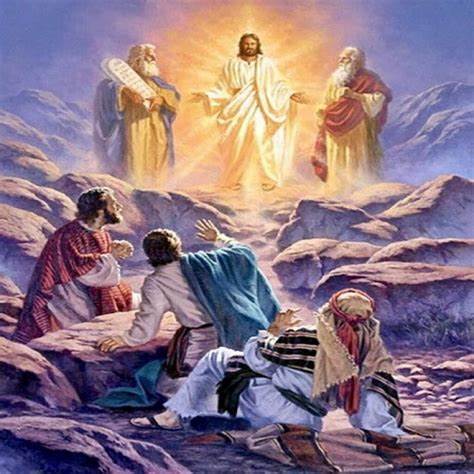
Moses and Elijah visited Jesus in the Transfiguration possibly to lift His spirits and remind Him of the glory of a successful earthly mission.
John became, in a sense, my Moses and Elijah. God sent John to me in much the same way, I believe, that he sent Moses and Elijah to Jesus during the Transfiguration. Matthew, Mark and Luke give an excellent account of what happened during that supernatural encounter. But only Luke hints at why they appeared or what they said. Luke writes they “spoke of his exodus that he was going to accomplish in Jerusalem.”
What??
Would God, the Loving Father, really send these two pillars of heaven to remind his Son – as if Jesus really needed reminding – that he would be betrayed, tortured and crucified in a matter of months? Sorry, I’m not buying it. Maybe a look at the timeline of Jesus’ earthly ministry may give us a different look.
After a couple of years of preaching and teaching, healing and exorcisms, it’s well within reason to believe Jesus was feeling the pressure of failure. He knew time was running out. His true message just wasn’t getting through. He amassed thousands of followers who wouldn’t leave Him alone, not because they understood His message about the Kingdom of God but because they wanted more loaves and fishes, and hoped for liberation from Rome. He was even vexed by His own apostles, asking them in frustration, “Do you still not understand?”
Jesus’ ministry threatened the prevailing power structure of Israel – both Rome and the Jewish religious hierarchy, especially the ruling Sanhedrin.
Not only that, the religious and political establishments were coalescing in deadly opposition. To them, He had grown from a minor irritant to a legitimate threat to the political, social, and economic structure they ruled. It was only a matter of time before they put an end to it – and Him. Jesus knew that even before they did. He had known it most of His life. But having to endure it was just so difficult!
At this point in his ministry, how could Jesus’ human nature not be disheartened and dispirited. It’s not ridiculous to think that, in this most critical endeavor in the history of the cosmic universe, Jesus, the human being, felt He was failing.
We are never beyond God’s healing touch, sometimes directly through our hearts and sometimes through family and friends who love us.
God, the Loving Father, knew that Jesus, the human Son, needed a heavenly boost. Moses and Elijah likely reminded Jesus that He could – would – persevere, accomplish His mission and reconcile all humanity to the Father. That the entire realm of heaven would explode in glory when He finally defeated death. That His death and resurrection would secure the Kingdom of God for all eternity. Just hold on a little longer.
God even added a cherry on top for Jesus, audibly saying, “This is my beloved Son. Listen to him.”
A Loving Father comforts His suffering children. All of his children. Yes, including us. Sometimes He whispers to our hearts. Sometimes he sends surrogates. Like Moses. Or Elijah. Or a John Thomas. But He sends comfort. Just ask.
Because nothing is ever too difficult.
If you liked this story, I hope you will choose to subscribe. Just scroll down, enter your email address and click “Subscribe.” I try to upload a new entry every couple of weeks or so.
I saw the listing for a two-day substitute teaching opportunity and couldn’t help but smile. I just had to take the job. It wasn’t the subject – English – that grabbed me, although I do tend to prefer subbing for English and music teachers. It wasn’t the timing either – a Thursday-Friday assignment to close the week. Nor was it the expected ease of the assignment – likely handing our worksheets or proctoring tests. In truth, what attracted me to the job was irony, specifically the teacher’s last name – Welch.
My original last name.
I asked the office to edit the “trusted adult” sign while I was subbing here, still unsure of the “adult” status. They said only chronological age counts, not maturity.
As you may know, I am an adoptee with an atypical origin story. I only learned it a few years ago and could only reveal it last year. My biological mother’s name at the time of my birth was Welch. She changed her name to Barone when she married my biological father; my name became Casella shortly after I was born when Connie and Tony Casella adopted me. (Good thing. I really don’t think I look like a Welch!)
The irony of the sub job wasn’t just the Welch name, however. It also the timing.
Part of my Lenten routine has been a daily audio reflection that asks participants to seek God’s plan for each of us. Discernment has never been one of my strengths. Trying to determine where God wants me to go and what He wants me to be inevitably raises a couple of basic life questions – Who am I? and How did I get here? I’m sure these are questions you’ve asked yourself, too. For me, the questions are reminders that I come from two families – one responsible for nature, the other for nurture.
I share biological traits and influences with my birth parents and siblings. My attitudes, ideas and values were instilled by the parents and extended family who raised me.
The Barone side – the “nature” – gave me my appearance, my height (or lack of it), my walk, and the sound of my voice. Nature also seems responsible for many of my preferences and ways of doing things: tea (bag in!) instead of coffee, affinity for hair (it’s actually vanity – thanks Dad!), guitar, and other inclinations. And, as with all of us, I also share congenital issues with my biological parents and siblings.
The nurture side, behavioral influences, came from Connie and Tony Casella, the parents who raised me. These include my moral code, including my religion and my attitude toward God. Their example helped me define society and my place in it – my attitudes towards education, government, sports, finances, and other routine aspects of life. They also modeled interpersonal approaches – how one treats others and navigates relationships on every level of society.
Lent is a time for us to discern that path God wants us to take to become the person He wants us to be.
It is from these deep-seated influences – biological and cultural – that I must reassess in order to fully discern and accept God’s will for me. That’s what God is asking all of us to do – to risk the person we have become, to become the dynamic person God wants us to be. That’s unnerving. But that’s faith – all of us trying to replace “me” with “He.”
In the meantime, I’m exceptionally grateful for the imprints from both families. I’m also grateful for God’s patience with me. I hope that, one of these days, I’ll finally discern His plan for me. I don’t know if I’ll get there. I often doubt that I will. But as long as He doesn’t give up on me, I’ll keep trying. I hope you do, too.
If you liked this story, I hope you will choose to subscribe. Just scroll down, enter your email address and click “Subscribe.” I try to upload a new entry every couple of weeks or so.












 Now What?