Malchus – A Story within a Story

People love a good story. We are storytellers at heart. We all experience the human adventure through stories.

Holy Week is one of those times in the Christian calendar that is rich with some of the greatest stories in human history – among them are the Last Supper, Judas’ betrayal and Peter’s denial, Jesus’ arrest, crucifixion and resurrection. These contain some of the greatest lessons in human understanding. The lights of these events shine so brightly, they tend to overshadow the stories within these stories.

Such is the case of Malchus.

Malchus was the slave of Caiphas, Israel’s high priest during that fateful Passover two centuries ago. Called a slave, Malchus was likely a ranking member of the high priest’s household. Think “executive secretary,” or “personal assistant.” As such, he most likely was well-schooled in Jewish law, scripture, and prophesy, and privy to all the high-level political plots.

In other words, Malchus was a smart guy and, as a fly on the wall, an ultimate insider. His story was notable enough to be mentioned the gospels, yet overshadowed by some of the most significant events of all time. Still, his story should register with all of us who ever contemplated the divine.
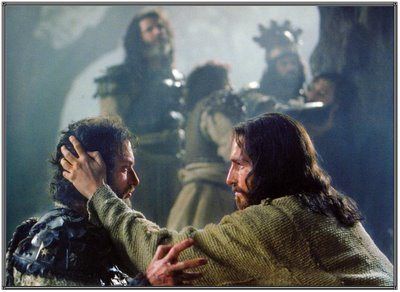
Jesus heals the wound of Malchus, the high priest’s slave, after one of the disciples cuts off his ear.

Malchus accompanied the temple cohort that arrested Jesus. According to all four gospels, one of the disciples – John 18:10 claims it was Peter – cut off Malchus’ ear.

This was NOT what Malchus signed up for.

Like most everyone else, Malchus was probably quite curious about this strange preacher. He’d heard all the stories about the signs and wonders. He couldn’t escape the shouts of “Hosannah to the Son of David!” that echoed through Jerusalem just five days earlier. And while Jesus caused a scandal routing the merchants and moneychangers from the Temple’s Court of the Gentiles, he had no reason to expect any significant resistance to the armed guards. Yet, here he was now, stunned and bleeding profusely from the gaping wound on the side of his head.
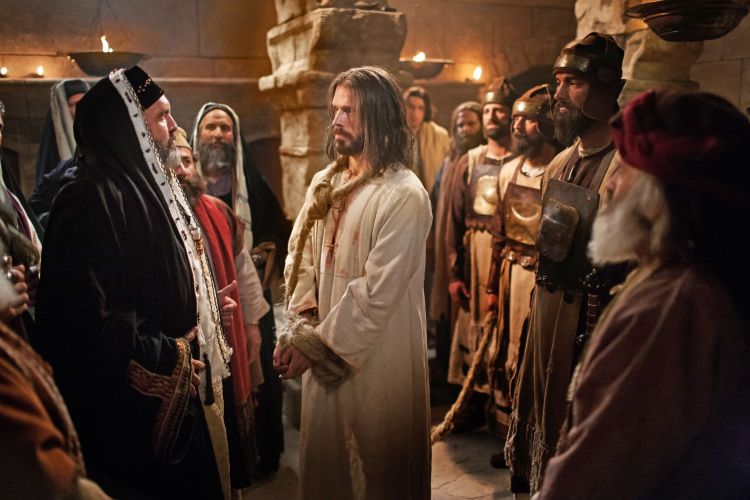
Following his arrest in the Garden of Gethsemane, Jesus is brought to the high priest Caiphas for trial
by the Sanhedrin.

As he howled through the pain, Malchus must have thought Caiphas and the council were right – Jesus IS dangerous, a threat to Israel, to the Temple, to the nation, to their entire way of life. He’s a blasphemer, an affront to God, a destructive agent of evil. While grabbing at his wounded ear, his good ear picks up something about putting down a sword. He sees Jesus reaching for him out of the confusion, touching the throbbing side of his head and – WOW! Searing pain gone. Wound healed.

Who IS this Jesus guy?
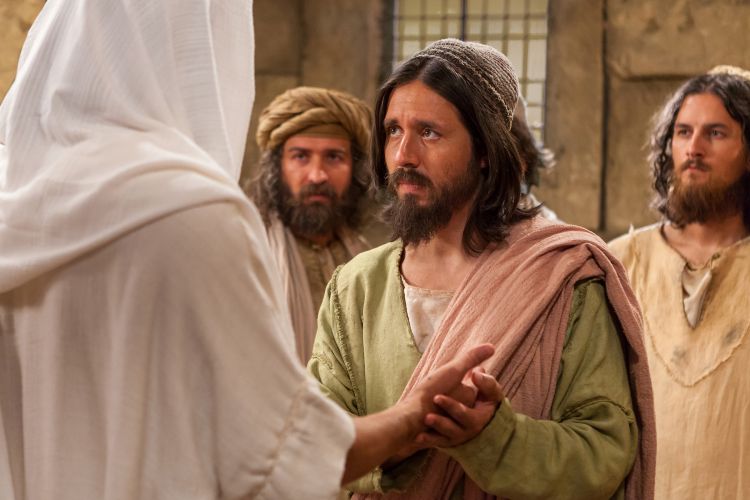
The Risen Christ tells Thomas, “Blessed are those
who have not seen and yet believe.”

Malchus – immersed in the law and traditions of Israel, inoculated against Jesus by the daily denunciations from Israel’s esteemed leaders – felt the ground shift beneath him. It was one thing to hear fantastic stories of all the supposed miracles this nomad preacher reportedly pulled off. But to be on the receiving end of an actual honest-to-goodness healing changed the entire landscape. This was cognitive dissonance in the extreme.

We don’t know if Malchus saw and believed. He is never again mentioned in any Bible text or historical document. Maybe he stuck with the religious establishment claiming Jesus’ resurrection was just another fraud. But just maybe Malchus became a believer. What we do know is that, ten days later, the risen Jesus told Thomas, “Blessed are those who have not seen and yet believe.” We don’t have to lose an ear to hear that message.

If you liked this story, I hope you will choose to subscribe. Just scroll down, enter your email address and click “Subscribe.” I try to upload a new entry every couple of weeks or so.


People of All Colors – Even Green and Orange!

“It’ll be about five-ten minutes,” the hostess told me with sweet, Southern charm.

It was a Tuesday morning and I was looking for a quick breakfast before getting on with my day. The neighborhood southern-style restaurant, part of a chain, had a breakfast buffet that checked the “quick” box, but I hadn’t counted on hitting the morning rush.

“Wait,” I countered. “Don’t you have a back room?”

The hostess hesitated.

“Uh, yes,” she said tentatively. “You sure you want to sit there?”

“Sure,” I responded, looking at my watch. “Why not?”

The breakfast buffet was open to all, but some patrons of the neighborhood chain restaurant were relegated to the small, rear dining room.

In the back room, one family crowded around a single large table. Several other tables were unoccupied. I half-wondered why, but was still focused on how quickly I could get out of there. I was just grateful for the quick seat in a quieter spot to scan the morning paper as I ate.

At the buffet, as I scooped a spoonful of eggs onto my plate, I surveyed the crowded dining room. I couldn’t quite cut through the morning fog of cognitive dissonance – one space full, another space near-empty. I stepped back into the back room with my breakfast plate, surveyed the big open space and thought, ‘I guess we’re the second-class citizens.’ That’s when the realization hit me full force.

We were the second-class citizens. All the patrons in the front dining room were white. I sat in the back with the only black people in the place.

A full 20 years after the Beatles refused to play in Jacksonville unless the crowd was desegregated, I found myself in a restaurant that seated whites and blacks in different rooms.

It was yet another reminder that I was back in the Deep South. After growing up in the ethnic northeastern city of Syracuse, New York, I had taken a job as a TV reporter in the Mobile, Ala. – Pensacola, Fla. market. While I had immediately fallen in love with Florida, I felt out of place in such a “whitebread” culture. I remember jokingly asking my news director the location of the Italian section of Pensacola, so I could find a place to rent there. His teasing but accurate response was, “Wherever you live is the Italian section.”

After a year-and-a-half in the Florida Panhandle, I spent the next four years in the wonderfully multicultural city of Miami. I felt at home in the rich ethnic environment.  Indeed, one friend noted my Italian features and Florida tan by saying, “This place is perfect for you; you can pass for anything – except Haitian!”

But it was now 1984. A career correction pushed me geographically north, up the Florida coast but, culturally, back to the South of the 1950s where too many people were still proudly fighting a war that ended more than 120 years earlier.

My father turned a department store aisle into a classroom for a simple but powerful lesson I
would never forget.

For me, that war and its racist attitudes were largely confined to their rightful place in the history books. I credit a five-word sentence from my father for that. One day, when I was about three or four years old, dad was toting me around a Shoppers Fair store. Looking around the aisles, I was conscious, for the very first time, that there were people whose skin was a whole lot darker than mine. I gripped my father tightly around the neck and told him I was scared. He chuckled and reassured me, saying, “People come in all colors!”

“Really?” I asked in wonder. “Red? Blue? Orange?”

“Yes,” he laughed, allaying my fears as I started looking all over for green and purple people.

After my experience at that restaurant, I wish I could say I did something effective, something that made a difference, other than answering “no” when the cashier asked if everything was alright. But being new to town, I was an outsider. Outsiders seldom have power – much like the hookers and lepers, the Samaritans and tax collectors of Jesus’ time. While it can be hard to be like Jesus, it’s easier to be more like my father, trying to neutralize our fear of “the other” by the way we live. Avoiding “polite” racism. And going to more places like the old Shoppers Fair that welcome people of all colors – even red, blue, and orange.

If you liked this story, I hope you will choose to subscribe. Just scroll down, enter your email address and click “Subscribe.” I try to upload a new entry every couple of weeks or so.