… But Sometimes “No” is a Good Thing

No, this headline is not a mistake, despite the title of my last post – Escaping the “No Place.” A dear, insightful, faithful soul, Jim Goodell, music director at Our Lady Star of the Sea Catholic Church in Ponte Vedra Beach, made a keen observation. He noted that sometimes it’s necessary to say “no” in order to say “yes.”

Here’s one example that may sound familiar: If I had said “no” to those couple of late-morning chocolate chip cookies I just scarfed down, it would help to eventually say “yes” to the jeans hidden in the back of the closet for the past several months.

In addition to his duties at Our Lady Star of the Sea, Jim Goodell (left) is also founder, producer and singer for the Bella Voce Cabaret.

Yeah, that’s a pretty trivial example. But it clearly illustrates how getting rid of one roadblock can make possible something even better. Saying “no” can be a critical part of our everyday lives in ways that enrich us and those we love.

Maybe this one time, guys, it would be prudent to say “no” to watching the game at a sports bar with your buds so you can say “yes” to a relaxing day trip to reconnect with your wife. And ladies, can you say “no” to that grocery run? If so, you can say “yes” to a glass of wine and some “remember when” time with your husband.

Sometimes spending time with family or a spouse is worth watching a game at a sports bar with friends.

Yes, I know – gender stereotypes. But easily understood stereotypes make points quickly, and gender roles isn’t the main topic, so maybe you can cut me a little slack? Hey, it’s not like I don’t cook and clean too. Right Helen? (Uh… Helen??)

So Jim is right – saying “no” can lead to many more rewarding yeses. And he notes these things aren’t limited to our daily routines. Saying “no” can also apply to more significant aspects of our lives.

No one likes being the “odd man out,” the one nonconformist who becomes the center of attention by being different. The one holdout on an 11-1 jury vote. A lone Dallas Cowboys fan at a Philadelphia Eagles’ home game. Wearing a tux to a toga party. Our tendency as humans is to blend in, not be “that guy” or “that lady.” But that’s exactly what Jesus commissioned us – through the Apostles – to do: “Go into all the world and proclaim the good news to the whole creation” (Mk 16:15).
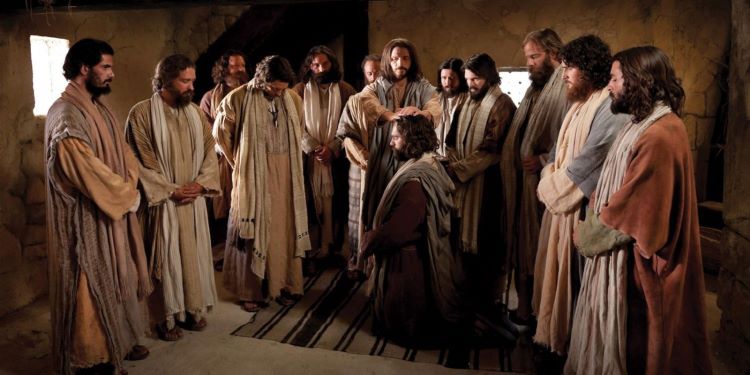
Jesus commissioned all his followers, through these
12 apostles, to spread the Good News of salvation throughout the world.

Engaging the Holy Spirit, the Apostles and their successors were so successful, Christianity became the societal norm through much of world over the past 2,000 years. As such, it wasn’t so tough to talk about God, Jesus, and religion. Today, the popular American “normal” is shifting to “no God.” Even a former president’s son is widely promoting the Freedom from Religion Foundation, saying he’s “not afraid to burn in hell.” So when you have to fight against the tide of society, it’s easy to say “no.”

This is the “no” we have to overcome to say “yes” to Jesus’ commission. That “yes” may bring ridicule and embarrassment. You may even alienate a few friends and family members. That’s a big risk. Then again, countless spiritual predecessors risked – and lost – their lives for saying “yes” to Jesus. In that context, risking embarrassment and ridicule isn’t so bad. It’s good timing, too. With Lent fast approaching, sacrificing our pride may be easier than giving up cookies – even chocolate chips!

If you liked this story, I hope you will choose to subscribe. Just scroll down, enter your email address and click “Subscribe.” I try to upload a new entry every couple of weeks or so.

Escaping the “No” Place

It’s one of the first words we learn as a new human – right after “Ma-ma” and “Da-da.” The word is “No.” It’s built into our DNA.

“No” is easy – We don’t have to do anything. “No” is smart – We can keep our money in our pocket. “No” is safe – we risk nothing. “No” is like hunkering down underneath a great big, thick, security blanket on a cold winter night.

Babies generally say “Mama” at about six months of age. “No” often follows closely behind.

Our country was founded on “no:” No ridiculous British rules, no unfair British taxes, and definitely no British-imported tea – English breakfast or otherwise. That little disagreement with King George III instilled quite a contrary streak into our national fabric, and probably was the American advent of the petulant admonition, “You’re not the boss of me!”

Our laws are largely defined by “no” – things we’re not supposed to do, such as exceed the speed limit, cheat on our taxes and beat up other people. There’s only one inescapable “yes” law we have in the United States – one thing we’re all required to do – and that’s pay our taxes. All the other pro-active laws and regulations arise from optional activities we choose, such as drive a vehicle, open a business or attend an event.

The Boston Tea Party was a very loud “no” that carried all the way across the Atlantic from Boston to Windsor Castle.

Still, the “no” psyche is not confined to Americans – not by a longshot. “No” is an inbred human survival instinct. In fact, one of man’s first documented moral codes, the Ten Commandments, is dominated with things we’re not supposed to do. Only two of the ten are pro-active – the Fifth, directing us to remember the sabbath, and the Sixth, commanding us to honor our parents. The rest make up a list of some serious no-nos – including other gods, murder, adultery and stealing.

While the Ten Commandments are specifically associated with Judaism and Christianity, the concepts are universal to nearly every religion and culture throughout history. These directives promote safety and order, keystones to the stability of all societies. While they keep us safe and secure, they also create a “No” place, a place of sterility dominated by nothingness. That’s not a very desirable place to live.

A much better place is… well, you already know. Think about one of your nicest, bestest, most excitingest moment in your life. Was it a product of saying “no?” Probably not. Most good things come not from saying “no,” but from saying “yes.” “Yes” to that first kiss. “Yes” to the new job offer. “Yes” to your First Communion. “Yes” to that concert, or that ballgame. Saying “yes” opens doors. Saying “yes” gives meaning to life.

Among God’s greatest gifts are friends and family
who let you know they always have your back.

Saying “yes” creates relationships, both on the human level and even on the spiritual level. Jesus, during his time on earth, breathed life into the Ten Commandments and the 613 Jewish Mitzvot by consolidating them into the two Greatest Commandments: “‘You shall love the Lord your God with all your heart, and with all your soul, and with all your mind.’ This is the greatest and first commandment. And the second is like it: ‘You shall love your neighbor as yourself.’ The whole law and the prophets depend on these two commandments” (Mt 22:37-40).

Both of these greatest commandments are “yes” commandments, pro-active, directing us to do something – love! – not just sit back and say no. Admittedly, “yes” is harder than “no.” Doing nothing is easier than doing something. But we aren’t called to an easy life. We are called to a life with others, to love and care for each other, and to be loved and cared for. Jesus commanded us to “love one another as I love you” (Jn 15:12). If you think about it, knowing that the people you love have your back is like being wrapped a great big, thick, security blanket on a cold winter night.

If you liked this installment, or if you were challenged by it, I hope you will choose to subscribe. Just scroll down, enter your email address and click “Subscribe.” I try to upload a new entry every couple of weeks or so.