I’m assuming there’s a good chance, after reading the title, that you’re ready to put up your dukes. That’s okay; I get it. But before this gets personal, let me re-establish my bona fides: I am a devout and lifelong Catholic who went to public school K-8 before moving to a private, Catholic high school where we prayed at the beginning of every school day and before each and every class. We even had special Masses. Things you would expect in a Catholic school.
And, really, that’s my point. We all shared a common religion – except for my friend Howie Rothstein, but he chose to be there so he was cool with it. Students who go to public schools, however, have no choice. There’s no common religion. So why do school prayer advocates want to require prayer in public schools?
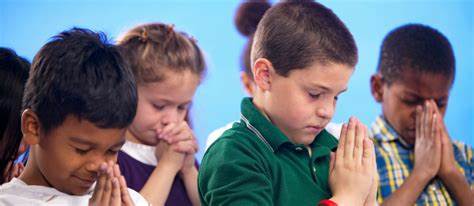
“Our nation has lost its way in having lost a belief of a higher power,” said one local school board member in Florida. “I hope it brings back our country to its foundation.”
Other advocates say school prayer can address maladies such as bullying, increased violence, mass shootings, teenage pregnancy, illegal drug use and more.
Okay. So which religion has such blanket transformative power? Remember, in public schools, all religions by law would enjoy equal favor. Most religious people in the U.S. belong to one of the many various branches of Christianity, so obviously Christian prayer would be included. What about a Jewish prayer? That should be okay – our Christian heritage is rooted in Judaism. Would parents welcome Islamic prayer in this political climate? Moreover, required school prayer would also legitimize atheism, Wiccan, and even Satanism, giving them a seat at the school-prayer altar. Do we really want our kids to pray “Dear God” on Monday and “Dear Satan” by Friday?
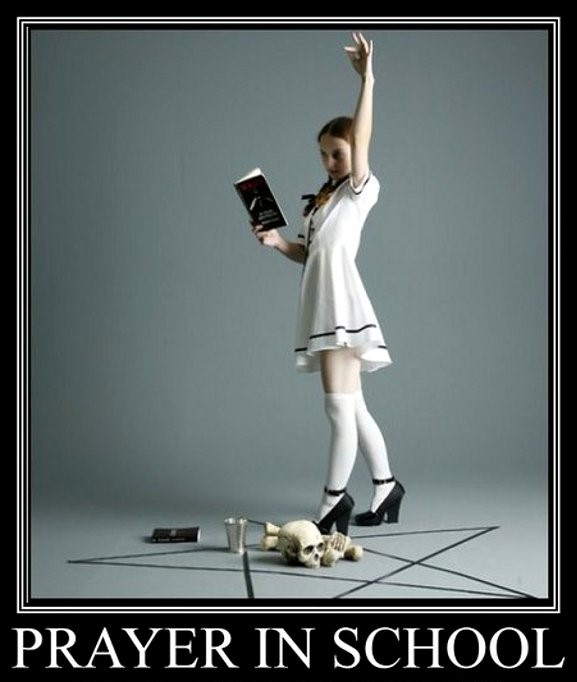
have in mind, yet this is what is possible if
prayer is ever required in public schools
If our Christian majority claims requiring prayer in public schools is necessary to remedy the ills of society, then we must not be fulfilling our responsibilities outside the classroom. Does that sound harsh? Well, it is harsh. But it’s also harsh to hear a 14-year-old boy defy me in the classroom by saying, “I’m not going to let some minimum-wage substitute nobody tell me what to do.” It’s even harsher when a police officer has to ask my wife, a full-time school teacher who’s been physically pushed around in class, “Do you want to press charges, Mrs. Casella?” Is school prayer the best way to address these bad behaviors?
It’s not the 1950s any more. Requiring prayer in public schools will not bring Wally and the Beaver back to the classroom. Heck, even Beavis and Butthead are long gone.
It’s ironic that a people blessed with free will by our Creator wants to force its will on other people to whom God has also granted free will. Forced prayer is the equivalent of beating someone until morale improves. It’s not just counter-productive; it’s contrary to God’s plan for us. So where does that leave us?
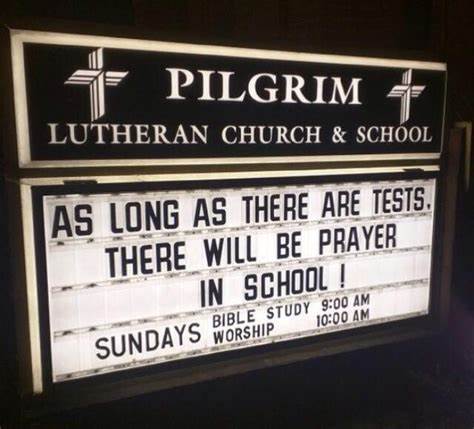
We are blessed to be in a nation in which no one can
prevent us from praying,
When parents send their kids to school, teachers act in loco parentis; in the absence of parents, teachers must act in the best interests of the kids. But parents still need to act like parents when they are there. And we all need to act as Christians all the time.
Jesus, commenting on the Pharisees, told his followers to “do what they say, not what they do.” As adults, we can distinguish that difference. Our kids can’t. Children do what we do; what we say matters less. And, because the largest single religious group in America is “None,” too many kids are not being exposed to the most important influence in our lives – actually, in the universe. That makes our example so much more important than ever. We must spread God’s love, peace and joy through our actions – not by force – to everyone we encounter, especially our children.
We want people to think “I want what they have.” That’s meaningful evangelization. That’s our commission straight from Jesus.
And that will have a far greater affect than any required school prayer ever could.
Feel strongly about the subject? Please leave a comment. Either way, I hope you will choose to subscribe. Just scroll down, enter your email address and click “Subscribe.” I try to upload a new entry every couple of weeks or so.

 Now What?