Thoughts of youth, denial and heaven 

I don’t consider myself old, just temporarily sidetracked. While I’m aware the only time I’ll lace a double down the right field line again is in my memory, I still held out hope, until recently, of cranking a 250-yard drive down the center of the fairway. But at what point do we eventually acknowledge our youth exists only in the rear-view mirror? I have a couple theories on aging especially for guys who know they’ll never get old. In other words, all of us.

I remember a glorious late spring afternoon some 15 years ago, sitting out on the patio of a downtown Armory Square pub in Syracuse, New York, enjoying a cold one with my dear friend Mike and some of his fellow middle school teachers. A few of them were teasing one young teacher in her mid-20s about her social life. After a few humorous barbs, she shared one particular frustration.

“I don’t get how these 50-year-old guys think they have a shot with me,” she exclaimed.

Since she didn’t know me from Adam, I bit my tongue. But as a then-50-year-old guy, I actually did have was a couple of answers. One of them was a dive into the male psyche.

A man’s denial of his own mortality is a lot deeper than most of us would ever admit.

“Old guys” who chase pretty, young women do so because that’s who they chased when they were young. Since we all actually think we are still young, why not? Looking in the mirror each morning, that hint of gray at the temples is an anomaly. The crow’s feet around the eyes are from too much sun last week. And the hairline isn’t any farther north at all. Since we haven’t gotten any older, why not chase women who are young, too?

Denial in excelsis.

I believe that type of denial, though, has a basis in reality. Deep in our innermost being, we believe all of our aches and pains, all of our maladies and diseases, are just temporary. That’s because innately know our bodies are just earthly holders for the spirit-beings we really are. Since we’re made in God’s image, our new spirit-bodies will be transformed. Perfect. Beautiful.

Until then, we’re stuck with the bodies we have. We can watch ballgames on TV and delude ourselves into remembering when we made plays “like the pros.” We can live vicariously through the exploits of our kids and grandkids. We can call on all the sweet (um, enhanced) memories of our youth.

But through that denial, here’s a bit of reality. To get that heavenly body, we need to actually make it to heaven. While I have no plans to trade in these used bones any time soon, my neurosurgeon has waved an obligatory red flag. After 40+ years of trouble, I’m finally getting my back fixed. Surgery tomorrow morning. I’m crossing my fingers I’ll end up 6-7 inches taller! Oops – there’s that denial again. Okay, maybe just 2-3 inches taller.

Prayers are welcome, of course, but here’s something even better. Set your own sights on heaven so someday, many years from now, we’ll be able to marvel at each other’s perfection. And maybe even play a heavenly round of golf!
Lessons from a $20,000 Mistake

Anyone who’s never done anything stupid – please raise your hand.

Yeah, thought so.

One of my biggest lowlights occurred in 1981. I needed a chunk of cash quickly. As a young TV producer-reporter working my second full-time job after college, I couldn’t just go out back and shake the money tree.  I didn’t have a money tree, of course, much less an “out back.” So I did a quick inventory to see if I had anything to sell.

Throughout high school and much of college, I played guitar in church. I had a nice, serviceable Yamaha acoustic that was perfect for that. But I also had an electric guitar and amplifier I hadn’t touched in years. Mom and Dad bought them for me when I was 10-years-old.

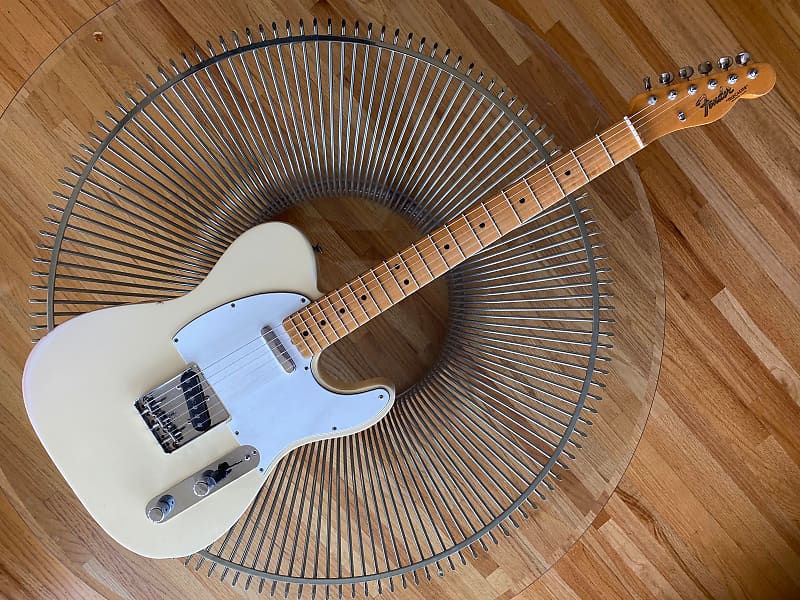
This 1966 Fender Telecaster was listed on Reverb for
$19,570.31 plus tax.

There was no eBay or Craigslist in 1981 to estimate its value, so I decided to offer this used, 15-year-old instrument for the original, full sticker price and crossed my fingers. I threw in the amp just to get it out of the closet. I wouldn’t ever be needing it again, would I? Still, I was a bit uneasy when I noticed the buyer – like me, a young guy in his 20s – looking like the cat who ate the canary. It prompted a little voice in my head to say, “You’re going to regret this.”

That’s how I came to sell my 1966 Fender Telecaster, polar white with a maple neck. For $300.

Fender makes it easy to find a guitar’s date of manufacture on the hidden end of each instrument’s neck.

Fast forward 25 years. A few of us musicians from the St. Joe’s church choir were getting together to play some classic rock and oldies at the parish fall festival. An acoustic guitar wasn’t going to cut it. That was the first time that little voice’s prophesy came true. But not the last.

Over the years I have gone through a few OK electric guitars, but none that felt or sounded as good as my old Telecaster. I missed it every time the guys got together for a festival, some other event, or just to jam. While I knew I could never get it back, I started using this new thing called the Internet to find another 1966 Fender Telecaster, a polar white one with a maple neck. And that’s when that little voice exploded into an ear-splitting scream.

If you Google “1966 Fender Telecaster” now, you’ll see those listed in excellent condition – which mine was – priced in the $15-20,000 range. The same guitar I sold. For $300.

As with any other tool, my new 2021 Telecaster only has value when it’s being used. Otherwise, it’s just a couple hunks of wood and some electronics in a box.

I decided to replace the guitar someday – same model, same neck, same color, but obviously different year. “Someday” came a couple of months ago. My new, 2021 model has the same look, the same classic Telecaster twang, and an even better feel. But now it has something even better – a smarter owner who realizes the best measure of value is not always in dollars.

Jesus taught us we must use the gifts God has given us. I now know that 1966 Telecaster was a great gift – but one that would have sat in its case unused for nearly three decades. Instead, at least one accomplished guitar player was able to put it to good use and derive great joy from it.

And I appreciate this new Telecaster much more than the old one. I can barely tell the difference between the two. Actually, the new one plays a little bit better. And now that I’m retired, it’s actually one of the answers to “Now What.” Now I can devote enough practice time to hopefully make me worthy of such a fine instrument. In other words, maybe selling the ’66 guitar wasn’t a mistake in the first place. Maybe it was simply a nudge from God.